Introduction
Most articles about leadership training topics read like catalogs. They list communication, delegation, conflict, and time management without explaining what each skill is actually for or why the order matters.
For project and operations managers, the challenge is rarely knowing which leadership skills matter. It is applying them between deadlines, shifting priorities, difficult conversations, and teams that depend on clear direction. A useful leadership program should prepare managers for the situations they face every week, not simply introduce leadership theory.
This guide outlines a practical curriculum built around the failures that disrupt project and operational execution. It explains what each topic is for, what breaks without it, what managers should be able to do afterward, how long each session may take, and how leadership training activities turn instruction into practice.

How to Choose Leadership Training Topics by Diagnosing the Failure
Effective leadership programs begin with diagnosis, not a menu of subjects.
Instead of asking, “What topics should we teach?” ask, “Where do our managers struggle?” Look for recurring, observable failures such as:
- Projects stall because every decision waits for one manager: delegation.
- Expectations and handoffs are unclear across teams: communication.
- Missed commitments remain unaddressed: accountability conversations.
- Conflict consumes time instead of producing solutions: conflict management.
- New employees receive inconsistent expectations and support: hiring and onboarding.
- Performance issues continue because feedback is late or vague: performance feedback.
- Managers spend their days reacting instead of prioritizing: time and priority management.
Each problem points toward a leadership capability. Choose the topic that gives managers a specific behavior to practice in response.
For project and operations managers, the goal is simple: build the skills that improve coordination, accountability, and team performance.
Delegation: Turning Responsibility Into Ownership
Delegation is often misunderstood as assigning work. In reality, it is transferring ownership while keeping accountability clear.
Many new managers continue doing the technical work themselves because they believe it is faster. That may solve the immediate problem, but over time it can create bottlenecks, contribute to burnout, and prevent the team from developing.
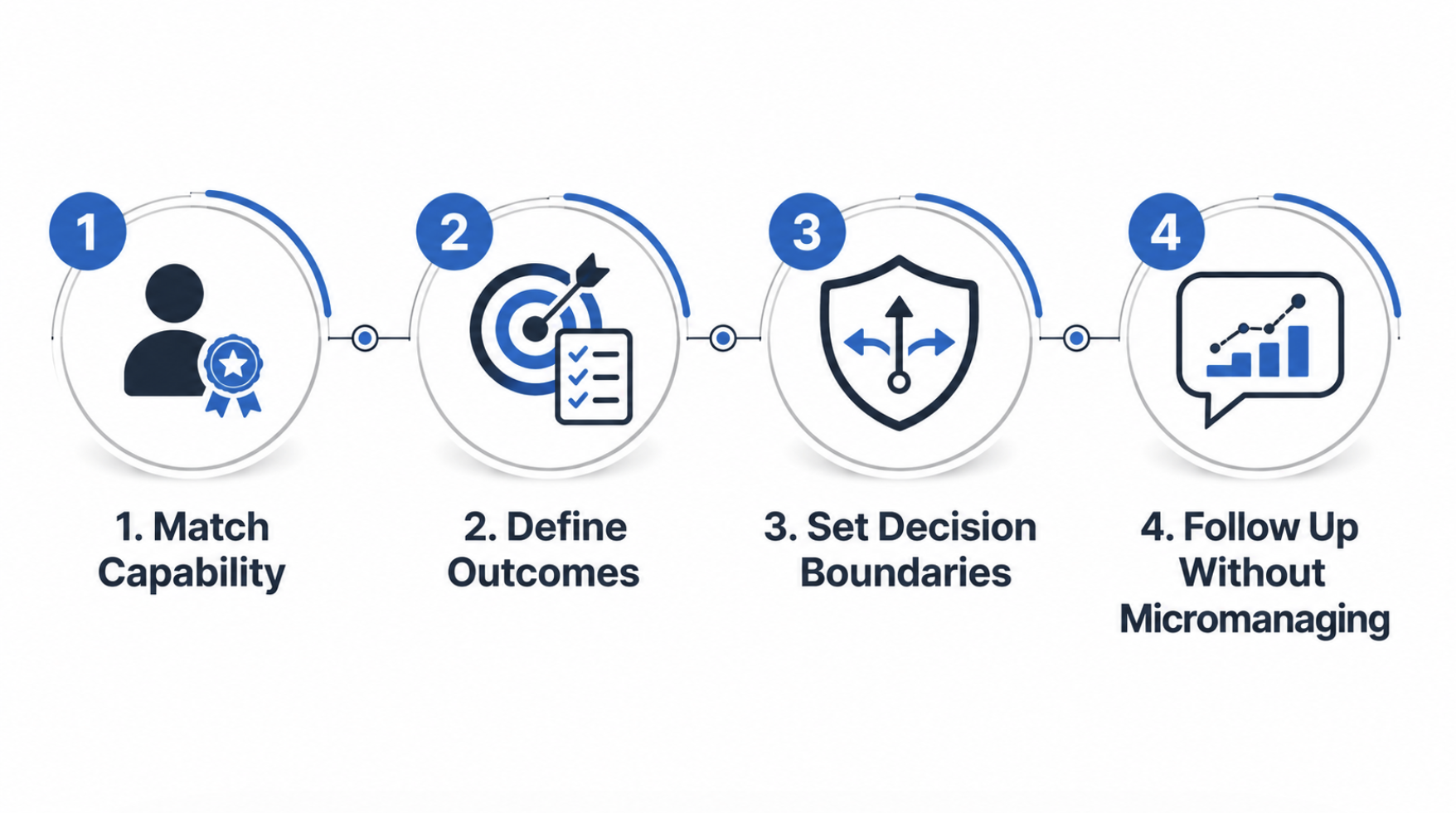
A leadership session on delegation should help managers learn how to:
- Match responsibilities to capability.
- Define successful outcomes clearly.
- Set decision boundaries.
- Follow up without micromanaging.
What breaks without it?
Projects become dependent on one person. Team members wait for approval instead of solving problems independently.
What good looks like afterwards
Managers spend more time coaching than rescuing. Team members know what success looks like and when they can make decisions on their own.
Suggested session length
Allow 60 to 90 minutes for instruction and practice. Use a current project task to create a delegation brief that defines the owner, expected outcome, decision boundaries, resources, and follow-up points. End with a role-played handoff and feedback.
Accountability Conversations: Addressing Missed Commitments Directly
Accountability conversations address the gap between an agreed expectation and the actual result. They help managers clarify the facts, explain the impact, confirm responsibility, and establish the next action without making the discussion personal.
What Breaks Without Accountability Conversations?
Managers often delay them for understandable reasons. They may want to preserve relationships, avoid confrontation, or hope the issue resolves itself. Unfortunately, delayed conversations often make problems larger.
What Good Looks Like Afterward
After training, managers should be able to use a repeatable structure:
- Describe the observable behavior.
- Explain the impact on the team or project.
- Listen before assuming intent.
- Agree on a clear next step, owner, and deadline.
- Schedule follow-up.
This approach keeps discussions focused on performance rather than personality.
Leadership Training Activity
Use role-play based on a missed commitment, delayed handoff, or repeated quality issue. Rather than memorizing scripts, participants practice staying calm, asking questions, and agreeing on measurable improvements.
Suggested Session Length
Allow 90 minutes for instruction, role-play, and facilitated feedback.
Communication That Reduces Confusion
Communication deserves a place in every leadership curriculum, but it should not dominate it.
For project and operations managers, effective communication is less about presenting confidently and more about reducing ambiguity. Teams need priorities, expectations, updates, and decisions delivered consistently.
A communication module should focus on:
- Giving clear project direction.
- Running concise team meetings.
- Writing actionable updates.
- Adapting messages for different audiences.
What Breaks Without Clear Communication?
Priorities compete, handoffs break down, and teams act on incomplete or inconsistent information.
What Good Looks Like Afterward
Managers give concise direction, confirm understanding, document decisions, and adapt messages for the audience.
Because communication is a broad leadership subject, Leadership Communication Training provides a deeper look at the skills managers use to set expectations, share decisions, and keep teams aligned.
Suggested Session Length and Activity
Allow 60 minutes. Have each manager rewrite a current project update or handoff, so it states the priority, decision, owner, deadline, and required response.
Conflict Management: Keeping Disagreement Productive
Conflict is not always a sign of dysfunction. In healthy teams, disagreement often leads to better decisions. The leadership skill is knowing how to prevent disagreement from becoming personal.
Project and operations managers regularly navigate competing deadlines, limited resources, and different stakeholder priorities. Training should prepare them to identify the shared objective, surface the concern behind each position, and guide the group toward a workable decision.
Key capabilities include:
- Identifying the real issue beneath the disagreement.
- Keeping discussions focused on facts.
- Facilitating collaborative problem-solving.
- Rebuilding trust after difficult conversations.
What Breaks Without Conflict Management?
Small issues escalate into recurring tension, delayed decisions, damaged handoffs, and avoidable senior-leader involvement.
What Good Looks Like Afterward
Managers address disagreements early, keep discussions focused on the work, and help teams agree on clear next steps before conflict affects delivery.
Suggested Session Length and Activity
Allow 75 to 90 minutes. Use a scenario involving competing deadlines or limited resources. Ask managers to identify the facts, each stakeholder’s underlying concern, the shared objective, and the next decision, then practice facilitating the conversation.
Hiring and Onboarding: Setting Clear Expectations From Day One
Hiring and onboarding training helps managers define the role, assess candidates consistently, and set clear expectations during a new employee’s first weeks.
Even when managers are not responsible for recruitment, they often influence interviews, onboarding, and early performance.
What Breaks Without Consistent Hiring and Onboarding?
Inconsistent onboarding can create uneven expectations that become performance problems later.
A practical leadership module should cover:
- Defining role expectations.
- Conducting structured interviews.
- Creating a consistent onboarding experience.
- Setting goals for the first weeks.
The objective is not to turn managers into recruiters. It is to help them create clarity from day one.
What Good Looks Like Afterward
Managers define roles clearly, follow consistent interview and onboarding steps, and establish early goals and follow-up points.
Leadership Training Activity
Participants can evaluate sample onboarding plans, identify missing expectations, and redesign a first-week experience with clear priorities, resources, points of contact, and check-in dates.
Suggested Session Length
Allow 60 to 75 minutes for instruction and application.
Performance Feedback: Turning Observations Into Clear Next Steps
Annual reviews rarely improve performance by themselves. Useful feedback is regular, specific, and delivered while work is still in progress.
Many managers fall into one of two extremes:
- They avoid feedback until formal reviews.
- They correct mistakes constantly without recognizing progress.
A balanced leadership program teaches managers to make feedback timely, observable, and actionable.
Effective feedback includes:
- Specific examples.
- Clear expectations.
- Collaborative problem-solving.
- Recognition alongside correction.
What Breaks Without Timely Feedback?
Employees may repeat avoidable mistakes, work toward different standards, or encounter performance concerns for the first time during a formal review.
What Good Looks Like Afterward
Managers address performance while the work is current, employees understand the expected standard, and both sides agree on a specific next step.
Suggested Session Length and Activity
Allow 90 minutes. Have managers practice giving feedback on a current performance issue using an observable example, the expected standard, the impact, and a specific next step. Include practice recognizing progress as well as correcting a problem.
Time and Priority Management: Focusing the Team on the Right Work
Individual productivity and leadership productivity are different.
A high-performing contributor succeeds by completing tasks efficiently. A manager succeeds by ensuring the right work happens through the team.
That shift requires different habits:
- Prioritizing high-impact work.
- Protecting time for coaching.
- Reducing unnecessary meetings.
- Distinguishing urgent from important decisions.
Rather than teaching productivity systems, leadership training should help managers align daily work with team objectives.
What Breaks Without Time and Priority Management?
Managers stay trapped in urgent tasks, coaching gets postponed, priorities shift without clear decisions, and important commitments lose attention.
What Good Looks Like Afterward
Managers identify the priorities that require attention, communicate tradeoffs, protect time for leadership work, and reset commitments when conditions change.
Leadership Training Activity
Managers can practice prioritization using realistic project scenarios where everything appears urgent. Afterward, they should explain what they prioritized, what they deferred, and how they would communicate those tradeoffs to the team.
Suggested Session Length
Allow 60 minutes for instruction and scenario practice.
Sequencing Matters More Than Coverage
One common mistake is teaching every topic in a single intensive program. Leadership development should give managers time to practice foundational skills before adding more complex responsibilities.
A practical sequence looks like this:
| Stage | Primary focus |
|---|---|
| Foundation | Delegation and communication |
| Team leadership | Accountability and feedback |
| Collaboration | Conflict management |
| People development | Hiring and onboarding |
| Operational execution | Time and priority management |
This progression starts with assigning work and creating clarity. It then moves into performance, conflict, people development, and broader operational priorities.
Teaching topics in the right order helps participants apply one skill before adding another. Treat the sequence as a starting point, not a rigid schedule. If one failure is already disrupting execution, move that topic forward.
How to Turn Topics Into Learning Sessions
Useful leadership sessions require participation, not just presentation.
Slides can introduce ideas. Practice gives managers a structured way to apply them.
Every leadership session should include opportunities to apply concepts through structured exercises rather than extended presentations.
Effective Leadership Training Activities
- Role-playing difficult conversations.
- Delegation planning workshops.
- Team meeting simulations.
- Conflict resolution scenarios.
- Feedback practice with peer coaching.
- Priority-setting exercises using realistic workloads.
These activities create space for reflection, discussion, and repetition, giving managers more than one opportunity to work through a skill.
A simple structure works well for most sessions:
- Introduce one leadership concept.
- Demonstrate it with a realistic example.
- Practice in small groups.
- Debrief what worked and what changed.
- Commit to one action participants will apply before the next session.
The emphasis stays on doing rather than observing.
What Is the Difference Between Leadership Training and Management Training?
Leadership training develops the people skills needed to guide, coach, and influence a team. Management training develops the process skills needed to plan, coordinate, and monitor work.
| Leadership training | Management training |
|---|---|
| Influencing people | Managing processes |
| Building trust | Planning resources |
| Coaching performance | Monitoring execution |
| Navigating conflict | Reporting and compliance |
| Developing teams | Coordinating operations |
Project and operations managers need both. Management keeps work organized, while leadership helps people perform consistently under changing conditions.
A practical curriculum integrates both perspectives because project and operations managers must lead people while coordinating work.
Building a Curriculum Managers Can Apply
A leadership curriculum should not be measured only by how many topics it covers. The better measure is what managers can apply in daily work.
For project and operations managers, prioritize leadership training topics they can apply immediately:
- Delegating with clarity.
- Holding accountability conversations directly.
- Communicating priorities consistently.
- Resolving conflict constructively.
- Supporting new employees effectively.
- Giving specific performance feedback.
- Protecting time for leadership instead of remaining in constant reaction mode.
Sequencing these capabilities and practicing them through realistic leadership training activities gives managers a practical way to apply each skill before moving to the next.
Trifecta Growth Institute’s Leadership Mastery Program combines structured learning, live coaching, and practical application to help developing leaders strengthen communication, delegation, accountability, decision-making, and consistent execution.
Frequently Asked Questions
What topics should leadership training cover?
Leadership training should cover delegation, accountability conversations, communication, conflict management, hiring and onboarding, performance feedback, and time and priority management. Together, these topics help managers lead people while coordinating project and operational outcomes.
What is the most important leadership training topic?
The most important leadership training topic is the one tied to the behavior or operational failure that needs to change. Delegation is often a strong starting point for project and operations managers because weak delegation can create bottlenecks, blur accountability, and limit team development.
How many topics should a leadership program include?
A practical program typically focuses on six to eight core topics rather than trying to cover every leadership concept. The final number should reflect the failures the program needs to address and leave enough time for managers to practice each skill.
What is the difference between leadership training and management training?
Leadership training develops people-focused capabilities such as coaching, communication, and conflict management. Management training emphasizes planning, coordination, and operational execution. Most project and operations managers benefit from both.
How long should each leadership training session be?
Most leadership training sessions should run 60 to 90 minutes when they combine focused instruction, discussion, and practice. The exact length should reflect the topic and leave enough time for participants to apply the skill and receive feedback.
Develop Stronger Leaders at Every Level
Project and operations managers need more than technical expertise. They also need practical skills for communication, delegation, accountability, and leading teams through daily challenges.
Explore Trifecta Growth Institute’s Leadership Mastery Program for structured learning, live coaching, and practical application that supports clearer communication, stronger delegation, better accountability, and consistent execution.