Introduction
A strong technician is often promoted into leadership because they know the work, understand the standards, and have earned the respect of their peers. What they may not have received is frontline leadership training.
That gap creates a predictable challenge for the employee and the organization. A skilled individual contributor suddenly becomes responsible for coaching others, resolving conflict, giving feedback, and being accountable for team performance. Without the right support, even capable employees can struggle during the transition.
Frontline leadership training prepares supervisors, crew leads, and first-line managers to lead the people responsible for day-to-day work. It should focus on setting expectations, communicating clearly, delegating work, coaching performance, handling conflict, and maintaining accountability, not executive strategy or high-level organizational planning.

What Frontline Leadership Actually Means and How It Differs From Management
Frontline leadership is the practice of leading the people closest to the work. These leaders supervise daily operations, support team members, communicate expectations, and help translate organizational goals into consistent execution.
While job titles vary, frontline leaders commonly include:
- Frontline supervisors
- Crew leads
- Team leads
- Shift leaders
- First-line managers
Their influence is immediate and personal. They shape employee experience through daily conversations, coaching, recognition, and accountability. Because they interact with their teams more than senior leaders do, their leadership often directly impacts morale, engagement, and performance.
Frontline managers also coordinate schedules, workflows, resources, and standards. Frontline leadership is the people’s side of that responsibility: setting clear expectations, building trust, addressing problems, and holding the team accountable in daily work.
Frontline Leadership vs. Management
Frontline leadership and management overlap, but they are not identical.
A manager may be responsible for planning, budgeting, staffing, and broader operational decisions. A frontline leader focuses on guiding people through the day-to-day work that keeps the organization moving.
| Frontline leadership | Management |
|---|---|
| Coaches people during daily work | Oversees broader operational planning |
| Builds trust and accountability | Allocates resources and priorities |
| Resolves team conflicts | Manages departmental performance |
| Develops individual employees | Coordinates across multiple teams |
Effective frontline leaders develop management capabilities over time, but their first priority is leading people effectively where the work happens.
The Peer-to-Boss Transition
Moving from teammate to supervisor is rarely as simple as receiving a new title.
Yesterday’s peer becomes today’s decision-maker. Friendships must coexist with accountability. Informal influence now carries formal responsibility. Many new supervisors discover that the skills that made them successful individually are not the same skills required to lead others.
This transition is emotionally challenging because identity changes before confidence does.
Common struggles include:
- Hesitating to give constructive feedback
- Avoiding difficult conversations with former peers
- Feeling pressure to prove competence
- Taking on too much work instead of delegating
- Confusing popularity with effective leadership
Without structured development, new leaders often default to doing the work themselves. That may solve an immediate problem, but it can limit team growth, create bottlenecks, and contribute to burnout. When performance issues go unaddressed and delegation breaks down, senior leaders may be pulled into routine decisions that the frontline leader should be equipped to handle.
Frontline leadership training helps new supervisors build leadership habits alongside their technical expertise. It gives them practical tools for communication, delegation, coaching, and decision-making before avoidance, overwork, and inconsistent accountability become routine.
What Frontline Leadership Training Should Cover
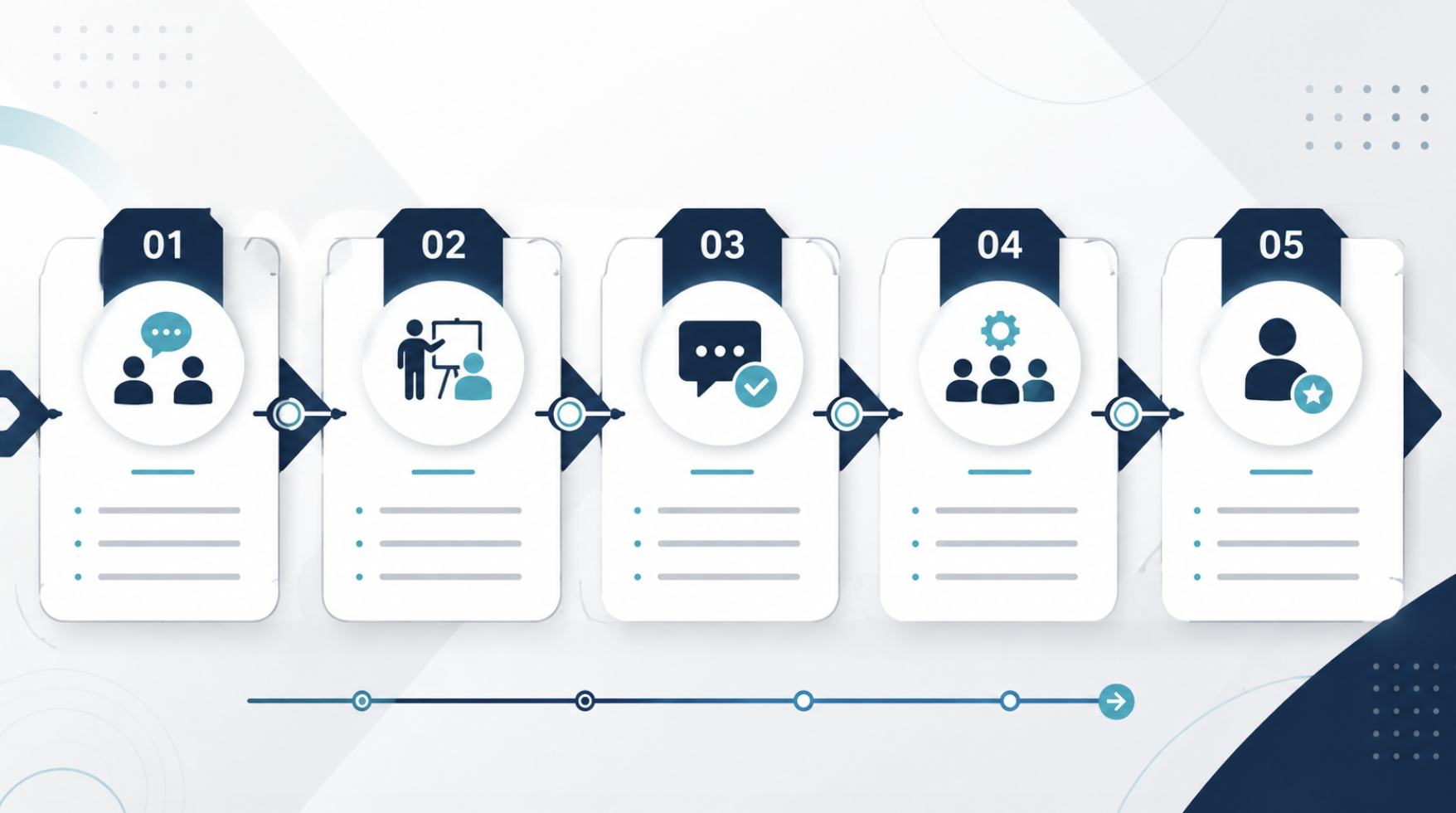
Frontline leadership training should be practical, role-based, and immediately applicable. It should help supervisors handle the situations they encounter every week, not center on abstract leadership theory disconnected from daily work.
Communication that creates clarity
New leaders quickly discover that unclear communication creates unnecessary problems. Expectations, priorities, and feedback must be consistent and specific.
Training should include:
- Setting clear expectations
- Active listening
- Leading productive one-on-one conversations
- Giving concise instructions
- Asking effective coaching questions
These skills can reduce misunderstandings while improving trust across the team.
Coaching instead of simply correcting
New first-line managers may feel pressure to have all the answers. Coaching helps them develop employees’ judgment and capability instead of solving every problem themselves.
Coaching skills should include:
- Identifying strengths and development areas
- Guiding problem-solving instead of providing every solution
- Recognizing progress
- Creating accountability without micromanaging
When supervisors become coaches, employees can build greater confidence and ownership.
Giving feedback early and well
Feedback is a core leadership skill because it helps address small issues before they become larger ones.
Effective training teaches leaders how to:
- Deliver timely feedback
- Balance positive recognition with constructive guidance
- Focus on behaviors rather than personalities
- Prepare for difficult conversations
- Address conflict before it disrupts the team
- Follow up with clear expectations
A consistent feedback process can support fairness and clear standards across the team.
Delegation and accountability
A common challenge for newly promoted leaders is trying to carry the same individual workload while also supervising everyone else.
Delegation is not avoiding work. It is intentionally assigning responsibility while providing the support needed for success.
Training should help leaders learn how to:
- Match responsibilities to capability
- Explain desired outcomes
- Check progress without hovering
- Hold people accountable respectfully
This shift can help teams build capability instead of becoming dependent on one supervisor.
Emotional intelligence in everyday leadership
Frontline leaders influence workplace culture through daily interactions.
Emotional intelligence includes recognizing emotions, managing reactions, and responding thoughtfully under pressure. Practical training may cover:
- Self-awareness during stressful situations
- Managing frustration professionally
- Reading team dynamics
- Responding with empathy while maintaining standards
These skills can improve relationships without lowering accountability.
Decision-making and problem-solving
Not every situation has a written procedure. Frontline leaders need confidence to make sound decisions within their responsibilities.
A practical curriculum develops the ability to:
- Prioritize competing tasks
- Evaluate risks
- Escalate issues appropriately
- Solve recurring operational problems collaboratively
Decision-making can become more consistent when leaders apply clear principles instead of memorizing answers.
What Frontline Leadership Training Should Not Cover
A common mistake is giving frontline supervisors the same leadership content designed for executives.
Senior leadership topics certainly have value, but they are not the immediate developmental priority for someone leading a crew or first-line team.
Training should avoid emphasizing subjects such as:
- Corporate strategy development
- Board-level governance
- Executive financial planning
- Organizational restructuring models
- Enterprise-wide strategic frameworks
Instead, frontline leadership training should stay grounded in the daily realities of leading people, improving communication, resolving conflict, and building accountability.
Examples should mirror the situations frontline leaders actually face so they can practice applying the skills during daily work.
How to Tell Whether Frontline Leadership Training Worked
Frontline leadership training is working when leaders apply the skills on the job, and team-level measures improve over time. Attendance and completion show participation, not behavior change.
Evaluate leadership behaviors and relevant team-level results against a clear baseline, then review the pattern over time.
Key indicators include:
Employee retention
Compare retention and voluntary turnover within each leader’s team before and after training. Look for sustained patterns rather than treating one departure or short-term fluctuation as proof that the training worked or failed.
Fewer escalations
Track routine issues escalated to middle or senior leaders. A sustained decline may show that frontline leaders are resolving problems within their authority and escalating the right issues at the right time.
Improved team accountability
Look for clearer ownership, consistent follow-up, fewer repeated reminders, and delegated work completed to the expected standard.
Incident rates
Track safety, quality, conduct, or process incidents relevant to the team’s work. Changes in frequency, severity, and repeated causes can show whether leaders are identifying risks, reinforcing standards, and addressing problems consistently.
Stronger leadership behaviors
Observable behaviors matter as much as operational metrics. Look for improvements in:
- Quality of one-on-one meetings
- Frequency of coaching conversations
- Consistency of feedback
- Quality of delegation and follow-up
- Collaboration across the team
- Confidence during difficult discussions
The goal is consistent leadership behavior and better day-to-day execution, not simply completing a training program.
Building Frontline Leadership Training In-House vs. Buying a Program
Organizations generally choose between developing their own curriculum or partnering with an external leadership development provider.
Neither approach is universally better. The right choice depends on internal expertise, available resources, and long-term leadership goals.
Building an in-house program
An internal program offers:
- Alignment with organizational culture
- Company-specific examples and scenarios
- Flexible scheduling
- Integration with existing onboarding
However, creating quality leadership training requires significant time, facilitation skills, and ongoing updates.
Buying an external program
A specialized leadership development partner may offer:
- Structured learning frameworks
- Experienced facilitators
- Structured progression
- Consistent leadership language across teams
An external program may be a practical fit when an organization needs a structured curriculum, experienced facilitation, or implementation support that it does not have internally.
A blended approach can combine structured external training with internal coaching and manager support, helping frontline leaders continue practicing after formal training ends.
Organizations looking for structured learning, coaching, and practical application can explore Trifecta Growth Institute’s Leadership Mastery Program for people entering leadership and leaders refining their skills.
Frequently Asked Questions
What is frontline leadership?
Frontline leadership is the practice of leading employees who perform the organization’s day-to-day work. Frontline leaders include supervisors, team leads, crew leads, shift leaders, and first-line managers who coach employees, communicate expectations, and support daily performance.
What should frontline leadership training include?
A comprehensive frontline leadership training program should include communication, coaching, feedback, delegation, accountability, conflict resolution, emotional intelligence, and practical decision-making. The focus should remain on leading people rather than executive strategy.
How is frontline leadership different from middle management?
Frontline leaders supervise employees directly and focus on daily team performance. Middle managers typically oversee multiple teams, coordinate broader operational priorities, and connect frontline execution with organizational objectives.
How long does frontline leadership training take?
The length varies by organization and learning format. Many programs combine foundational workshops with ongoing coaching and practical application over time, allowing new leaders to build skills through real workplace experience.
How do you support someone promoted from within their own team?
Support begins by recognizing the peer-to-boss transition. New supervisors benefit from clear role expectations, leadership coaching, regular feedback, mentorship, and structured opportunities to practice difficult conversations, delegation, and accountability.
Develop Stronger Frontline Leaders
Promoting a capable employee into leadership is only the beginning. Frontline leadership training gives new supervisors a structured way to practice communication, delegation, coaching, and accountability in the situations they face every day.
Explore Trifecta Growth Institute’s Leadership Mastery Program for structured learning, live coaching, and practical application for people entering leadership and leaders refining their skills.