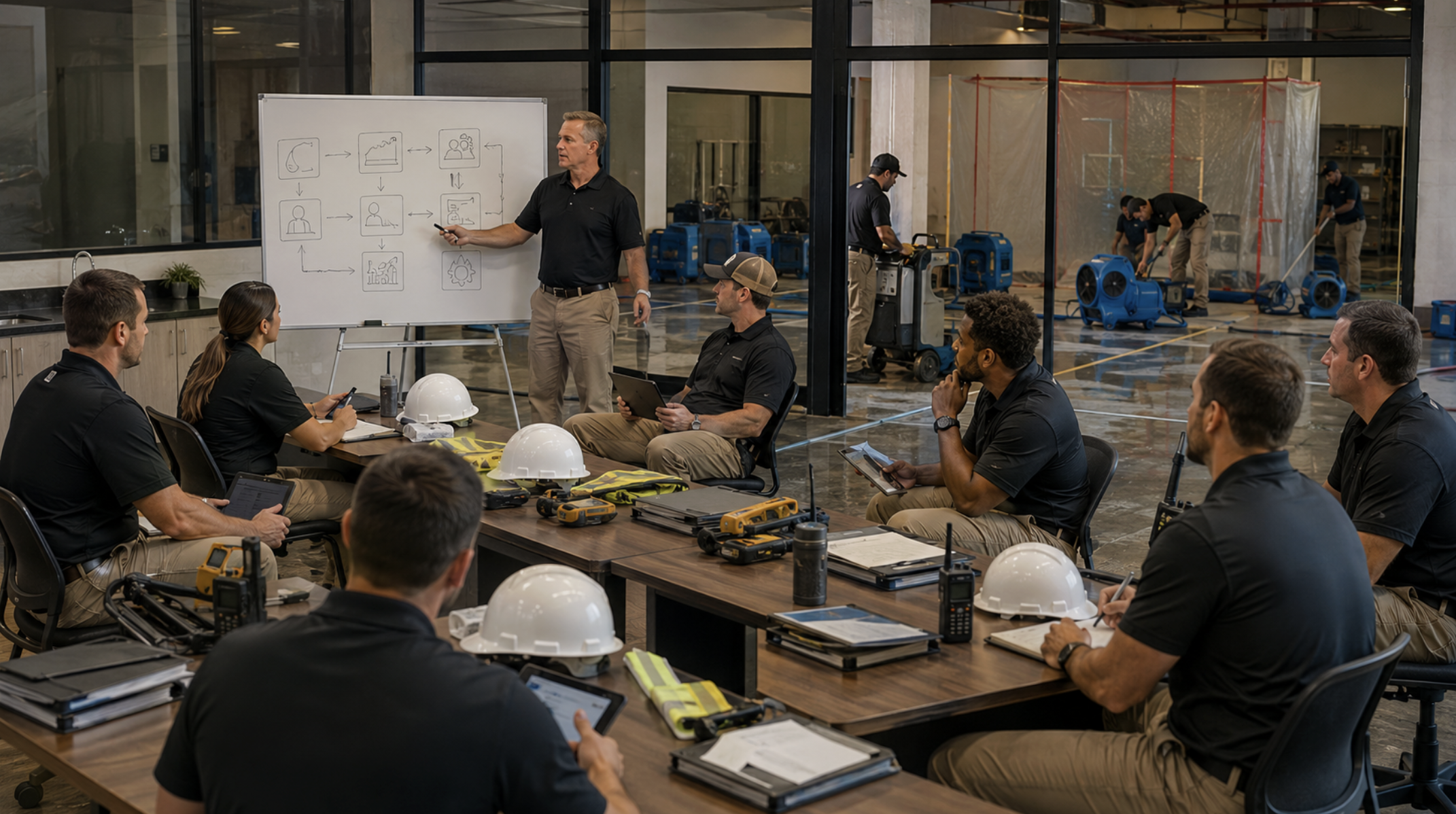
Most leadership development programs are designed for corporate environments and translate poorly to field-based businesses like restoration. If your team has sat through generic leadership development training that produced a certificate but little change on the job, you’re not alone.
Restoration leaders face different challenges than office managers. They make decisions under pressure, coordinate active job sites, communicate with crews and customers, and keep projects moving while balancing changing priorities. Programs built for traditional office environments rarely prepare leaders for those day-to-day responsibilities.
This article explains what to look for when evaluating a leadership development program for a restoration business, focusing on the structural elements that create lasting behavior change instead of one-time learning.
Not every leadership development program creates lasting behavior change. Some programs introduce leadership concepts but leave participants to apply them on their own. Effective leadership development programs follow a structured process that develops leadership over time, not through a single event.
Four elements separate effective programs from certificate-based training.
Progression Over Time
Leadership is built through consistent practice, not a one-day workshop. Effective leadership training and development gives participants time to learn a skill, apply it on the job, receive feedback, and strengthen it before moving to the next stage. This progression helps supervisors and project managers build confidence while managing real responsibilities.
Built-In Accountability
Without accountability, new skills are rarely sustained. Effective programs include regular checkpoints that reinforce learning and measure progress between sessions. For restoration leaders, that means applying skills such as delegation, difficult conversations, and day-to-day decision-making on active projects instead of limiting learning to the classroom.
Role-Specific Learning
Leadership responsibilities differ across restoration roles. A crew leader, project manager, and operations leader face different decisions, so they should not receive identical training. Effective leadership skills development focuses on the challenges participants manage every day, including coordinating multiple job sites, communicating under time pressure, resolving team issues, and maintaining customer communication.
Practical Application
Leadership improves through application, not theory. Every concept should connect to real job situations, whether setting crew expectations, delegating responsibilities, handling difficult conversations, or deciding when to resolve an issue independently versus escalating it. Practical application turns knowledge into consistent leadership behavior.
A leadership development program that combines progression, accountability, role-specific learning, and practical application develops lasting leadership behaviors. Remove any one of these elements, and the program is more likely to build awareness than measurable improvement.
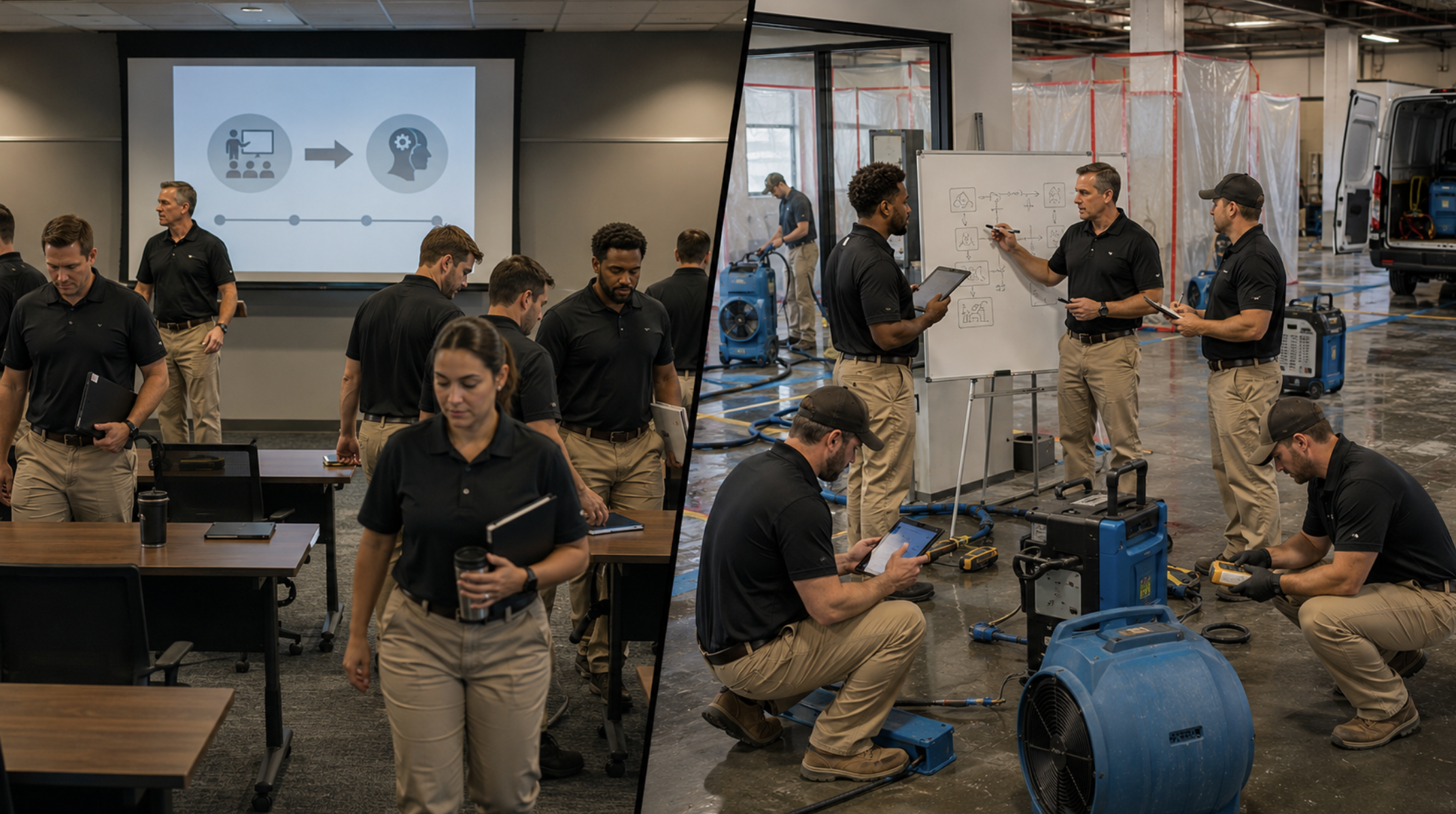
Many restoration business owners have invested in a one-day leadership development training workshop hoping it would solve ongoing leadership challenges. The session was engaging, the ideas made sense, and participants left motivated. A few weeks later, however, daily routines returned, and very little had changed.
That experience does not necessarily mean the training was poor. More often, it highlights the difference between a single learning event and a structured leadership development program. Workshops build awareness. Structured programs build lasting leadership habits.
A leadership workshop introduces new communication techniques, management principles, or leadership concepts in a short period. It can reinforce a specific topic or expose participants to new ideas, but the learning often ends when the session is over.
A leadership development program spreads learning over time so participants can apply new skills, receive feedback, and continue improving before progressing to the next stage. Instead of expecting behavior to change after one day, the program reinforces consistent growth through practice, accountability, and ongoing development.
| Leadership Workshop | Leadership Development Program |
|---|---|
| One-time learning event | Structured learning process |
| Builds awareness | Builds leadership habits |
| Limited follow-up | Ongoing practice, feedback, and accountability |
| Completion-focused | Behavior-focused |
For restoration businesses, this distinction matters because supervisors coordinate crews, manage active job sites, communicate with customers, respond to changing schedules, and make decisions under pressure. Those responsibilities require more than understanding leadership principles. They require repeated application in real work situations.
When evaluating leadership development programs, look beyond the curriculum or certificate. Ask whether the program includes structured practice, accountability checkpoints, and ongoing reinforcement. Those elements help leaders apply what they learn consistently instead of returning to old habits once the training ends.
Not every leadership challenge happens in a meeting room. Restoration leaders spend much of their day coordinating crews, managing multiple active job sites, navigating insurance timelines, responding to changing job conditions, and keeping customers informed during stressful situations. A leadership development program that overlooks these realities may teach sound leadership principles, but it will not prepare participants for the work they do every day.
Effective leadership development programs go beyond generic management topics by preparing leaders for the operational demands of restoration.
Role-Specific Learning for Field Leaders
Supervisors, project managers, and emerging leaders have different responsibilities, so they should not receive the same curriculum.
A strong program aligns learning with each role. For example:
Practical Scenarios Instead of Generic Case Studies
Many corporate leadership courses rely on office-based examples that do not reflect restoration operations. Leading a staff meeting is different from coordinating emergency response work, managing water damage projects, adjusting schedules throughout the day, or communicating with customers during active insurance claims.
Effective leadership skills development uses practical scenarios that participants encounter regularly, including:
Leadership Development That Supports Daily Operations
Leadership development should become part of daily operations, not another task outside the job. Effective leadership training and development encourages participants to apply new skills between learning sessions by leading crew meetings, delegating responsibilities, improving communication, and taking ownership of routine decisions on active projects.
A Structured Leadership Development Plan
An effective leadership development plan follows a clear progression rather than a collection of disconnected lessons. Each stage builds on the previous one, allowing participants to strengthen core leadership skills before taking on greater responsibility. Through structured practice, feedback, and real-world application, leaders develop habits that prepare them for the day-to-day demands of restoration operations.
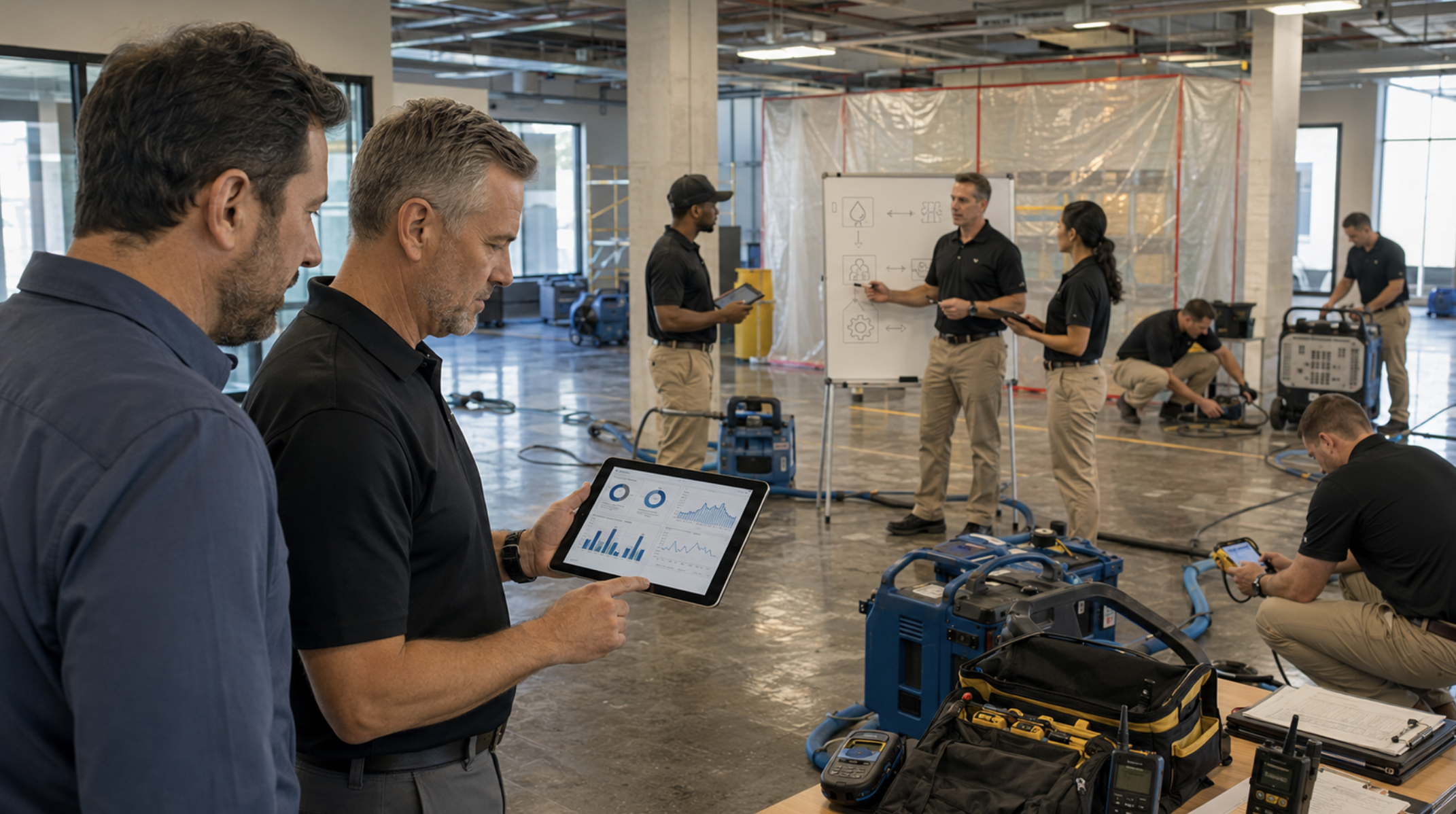
Choosing a leadership development program is not about comparing course outlines or price tags. The key question is whether the program is designed to change how participants lead once they return to the job. Look beyond marketing claims and evaluate how the program is structured.
Leadership Program Evaluation Checklist
Before enrolling a supervisor, project manager, or emerging leader, ask:
A long list of leadership topics does not guarantee an effective program. Evaluate how participants practice new skills, receive feedback, and continue developing after each learning session.
For restoration businesses, practical relevance matters as much as curriculum depth. A program should prepare leaders to coordinate multiple job sites, communicate with crews and customers, navigate changing project conditions, and make decisions under pressure.
The strongest programs provide a structured process for learning, application, feedback, and ongoing reinforcement instead of relying on a single training event.
Choosing the right leadership development program is only part of the equation. Many restoration companies limit their results by making a few common mistakes.
Choosing the Lowest-Cost Option
Price matters, but the lowest-cost program often delivers a one-time training session without the structure, accountability, or reinforcement needed to change leadership behavior. Evaluate long-term value, not just upfront cost.
Developing Only Senior Leaders
Waiting until someone becomes a supervisor or project manager is often too late. A stronger leadership development plan prepares emerging leaders before they step into greater responsibility, creating a more reliable leadership pipeline.
Expecting One Training Session to Change Behavior
A single workshop can introduce new ideas, but it rarely changes how someone leads. Effective leadership development training builds leadership habits through structured practice, feedback, and real-world application over time.
Ending Support After the Program
Leadership growth continues after formal instruction ends. Without follow-up, accountability, or opportunities to apply new skills, participants often return to familiar habits. Ongoing reinforcement helps new leadership behaviors become part of everyday operations.
Avoiding these mistakes starts with choosing leadership development programs that combine structured learning, practical application, and continued reinforcement instead of treating leadership as a one-time event.
A strong leadership development program should clearly show how participants grow over time. Trifecta’s Leadership Mastery Program is designed as a structured progression that combines practical application, coaching, and reinforcement instead of relying on a single training event.
The program is built for first-time leaders, supervisors strengthening their leadership approach, and executives looking to improve decision-making, communication, and team performance.
Rather than presenting leadership as a collection of disconnected topics, participants progress through a series of leadership competencies, including:
The program combines hybrid learning, instructor-led workshops, live coaching, and leadership retreats so participants can apply new skills, receive feedback, and continue developing between sessions. Instead of measuring success by course completion, the program reinforces leadership behaviors through practical application in day-to-day operations.
As you evaluate leadership programs, look for a structured progression that develops leadership through application, accountability, and ongoing reinforcement instead of a single training session.
Leadership development is a gradual process, so it’s important to set realistic expectations. The first 90 days focus on building leadership habits, not delivering every long-term business result. Starting with a leadership insights package helps establish a baseline, making it easier to measure progress as participants develop.
Early Signs of Progress
Early improvements are usually behavioral rather than operational. Leaders may begin making routine decisions they previously escalated, ask fewer clarifying questions about recurring tasks, delegate with greater confidence, and communicate clearer expectations to their crews. These are practical signs that participants are applying their leadership development training in day-to-day restoration operations.
What Takes Longer to Develop
Longer-term improvements, such as stronger employee retention, fewer callbacks, and more consistent project execution, develop over time as leaders continue applying new skills across different projects. Ongoing coaching, feedback, and accountability help reinforce those behaviors beyond the initial training period.
The first 90 days establish the foundation. Continued practice, reinforcement, and real-world application are what turn new leadership skills into consistent leadership behaviors.
What should a leadership development program include?
A strong leadership development program includes role-specific content, structured progression, built-in accountability checkpoints, practical application to real job situations, and ongoing reinforcement after the initial training. For restoration businesses, it should prepare leaders to manage crews, active jobs, customer communication, and decisions under pressure instead of relying on generic corporate examples.
How long does a leadership development program take?
Effective leadership development programs run over weeks to months, giving participants time to apply new skills, receive feedback, and build lasting habits. Single-day workshops build awareness but rarely change how someone leads day to day.
What is the difference between leadership training and a leadership development program?
Leadership development training is often a single learning event. A leadership development program is a structured process with milestones, practical application, feedback, and ongoing reinforcement that helps leaders consistently apply what they learn on the job.
How do I know if a leadership development program is working?
Look for practical behavior changes. Team members should solve problems independently, set clearer expectations with their crews, and require less owner intervention to close out a job.
Are leadership development programs worth the investment?
When a leadership development program is designed for the right role and followed through on, it can deliver long-term value. For restoration businesses, stronger leadership often contributes to reduced turnover, fewer callbacks, and more consistent project outcomes over time.
 Leadership Training Topics for Project and Operations Managers
 Leadership Development Tools: What Gets Used and What Gets Ignored
 How to Build a Leadership Development Plan for Operations and Project Managers
 Frontline Leadership Training: What It Is and What It Should Cover
 Leadership Communication Training: Building the Skills That Drive Results
 Leadership Assessment: Why It’s the First Step to Stronger Leaders
 Coaching Leadership Style: What It Is and How It Drives Team Performance
 Restoration Project Manager Salary: What to Expect and How to Advance
 Restoration Project Manager Certification: What It Is and How to Get Certified
 Leadership Development Programs: Building Stronger Leaders for Long-Term Success