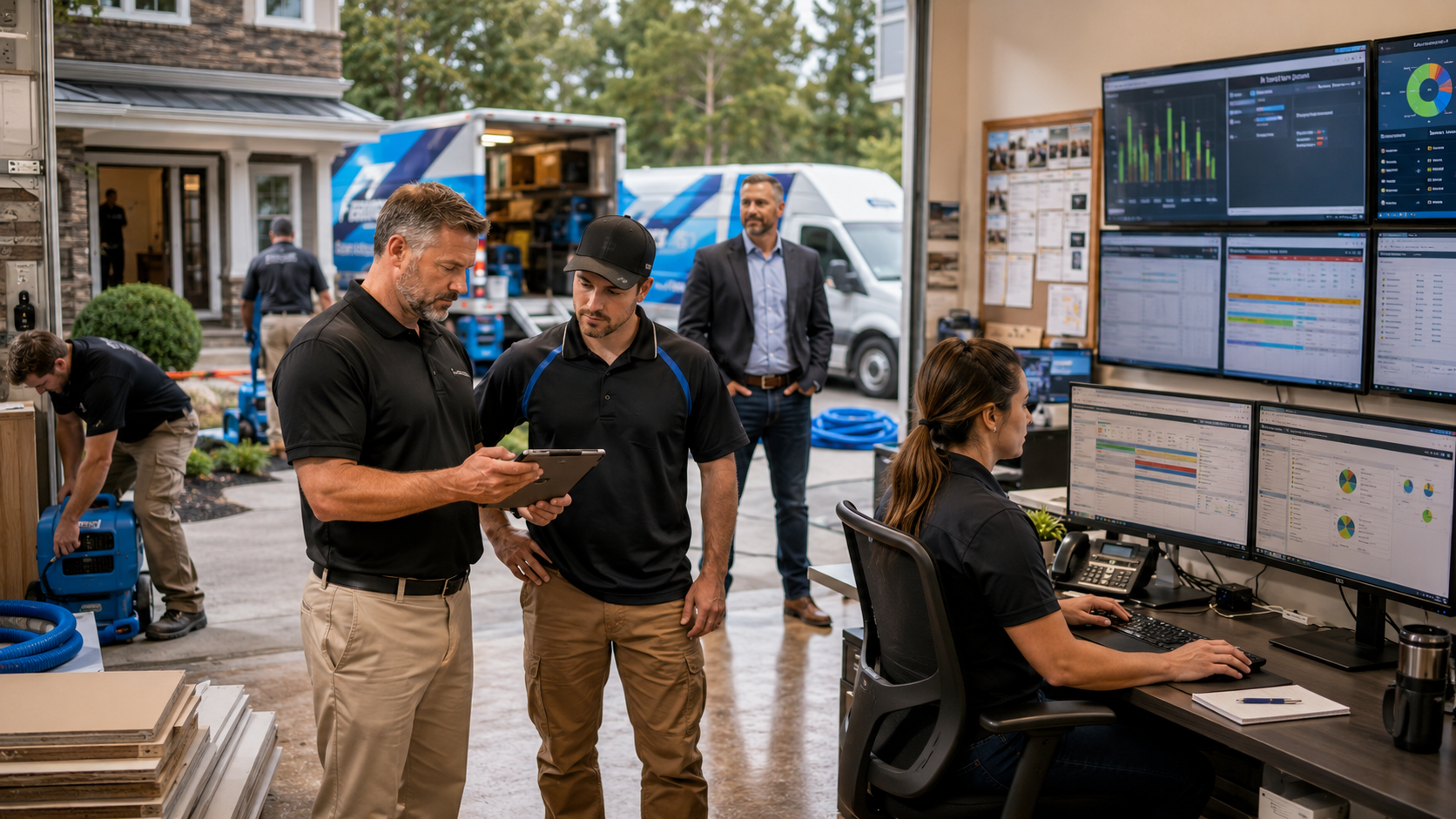
A restoration project manager who has never been properly trained can become one of the most expensive hires in your company. They lose jobs at the estimate, create documentation gaps that slow insurance approvals, miss supplements, struggle to manage crews, and allow timelines to slip. The result is lost revenue, frustrated customers, and an owner who gets pulled back into day-to-day operations.
The opposite is also true. A trained PM can manage multiple water, fire, mold, and reconstruction projects simultaneously, communicate effectively with insurance adjusters and customers, and drive accountability without constant owner involvement. That’s why restoration project management training is a critical investment for companies looking to scale.
This guide explains what quality restoration project management training covers, what generic project management training misses, and how to evaluate your options before committing.
NOTE FOR ROD: Consider adding a real example of an untrained PM missing moisture documentation, under-scoping a water loss, or mishandling a supplement that resulted in delays, insurance disputes, or lost revenue. A specific example would strengthen the business case for training.
General project management programs such as PMP, Agile, and CAPM teach valuable frameworks for planning, scheduling, and stakeholder management. However, those frameworks were not designed for the realities of restoration work.
Restoration project managers operate in environments shaped by emergency response, insurance claims, changing scopes, and customers experiencing property damage. They need to understand drying science, moisture documentation, mitigation workflows, reconstruction sequencing, and the documentation required to support insurance approvals and supplements. These are core responsibilities that most general project management programs do not cover.
A professional with a PMP certification may understand project schedules and resource allocation, but that knowledge alone does not prepare them to manage a water loss on day one. They still need to understand emergency-intake dynamics, communicate effectively with insurance adjusters, document moisture conditions, and coordinate the transition from mitigation to rebuild.
| General PM Training | Restoration PM Training |
|---|---|
| PMP, Agile, and CAPM frameworks | Water, fire, mold, and reconstruction workflows |
| Generic project schedules | Emergency response and mitigation timelines |
| Stakeholder management | Insurance claims and adjuster communication |
| Standard project delivery | Mitigation-to-rebuild project management |
| Broad project methodologies | Moisture documentation, scoping, supplements, and job profitability |
Effective restoration project management training is built around the actual job. That means industry-specific curriculum, restoration-focused frameworks, and instruction from professionals who understand the operational, financial, and customer-service challenges restoration project managers face every day.
Not all restoration project management training programs teach the skills needed to run restoration jobs successfully. A quality program should prepare project managers to manage projects from initial scope through final closeout while balancing operational, financial, and customer responsibilities.
Job Scoping and Documentation
Every restoration project starts with accurate scoping. Training should cover moisture mapping, scope writing, photo documentation standards, and the documentation required to support project execution and insurance review. Project managers need to identify affected areas, document conditions thoroughly, and create clear scopes of work that reduce delays, disputes, and costly rework.
Insurance Process and Estimating
Insurance-related work is a major part of restoration project management. PMs need to understand how to work with adjusters, what information belongs in an estimate, and how supplement cycles affect project timelines and profitability. Strong training helps project managers communicate effectively with carriers while ensuring documentation supports the work being performed.
Crew and Subcontractor Management
A restoration project manager coordinates technicians, subcontractors, vendors, and office staff across multiple active jobs. Training should focus on delegation, accountability, and daily communication systems that keep teams aligned and productive. The goal is to create consistency in the field without requiring constant owner involvement.
Timeline and Budget Management
Restoration projects move through multiple phases, including mitigation, demolition, reconstruction, and closeout. PMs need practical systems for building schedules, tracking costs against estimates, and managing change orders when project conditions change. Effective timeline and budget management protects margins while keeping projects on track.
Customer Communication
Customers are often calling during one of the most stressful situations they have experienced as property owners. Training should teach project managers how to set expectations, provide updates, navigate difficult conversations, and respond when timelines, scope, or project conditions change. Clear communication helps maintain trust even when challenges arise.
Job Closeout
The final stage of a project requires the same attention as the first. Quality training should cover final documentation, customer walkthroughs, payment collection, and closeout procedures that confirm the project has been completed according to scope. Strong closeout processes reduce callbacks, improve customer satisfaction, and support long-term business growth.
NOTE FOR ROD: Which specific training module or skill creates the biggest before-and-after improvement in project outcomes for restoration PMs? A real example from Trifecta’s program would be a strong differentiator here.
Most restoration professionals are balancing active projects, customer communication, and team responsibilities. As a result, training format can be just as important as curriculum when evaluating a restoration project management training program.
Online training offers flexibility and allows participants to learn at their own pace. This format works well for project managers who need to build skills while continuing to oversee water, fire, mold, and reconstruction projects.
Live training provides direct instruction, real-time feedback, and opportunities to learn alongside other restoration professionals. Many participants find that instructor interaction and peer discussion help accelerate implementation and problem-solving.
Trifecta offers both self-paced learning and live training experiences designed to support practical application in real-world restoration environments. Some programs also combine online coursework with coaching, workshops, or instructor-led sessions to reinforce learning and accountability.
Regardless of format, earning a certification typically requires completing a structured program and demonstrating competency through assessments. The goal is not just to complete training, but to develop the systems, leadership skills, and operational discipline needed to manage restoration projects successfully.
[ADD TRIFECTA FORMAT DETAILS: Online, live, hybrid, or combination model.]
One question restoration company owners frequently ask is whether project managers and coordinators should attend the same training program. In most cases, the answer is no.
A restoration project manager is responsible for job leadership, scope management, estimating, scheduling, field accountability, customer communication, and overall project performance. PM training focuses on helping leaders manage projects, crews, budgets, and outcomes from initial scope through final closeout.
A restoration coordinator serves a different function. Coordinators typically manage documentation, scheduling support, workflow coordination, communication systems, and administrative processes that keep projects moving efficiently behind the scenes.
Both roles are critical, but the skills required for success are different. Companies looking to strengthen operations often see the best results when they invest in both PM development and restoration project coordinator training.
If you’re unfamiliar with the PM role, see our guide on what a restoration PM does. You can also learn more about restoration project coordinator training and how coordinators support successful project delivery.
Not all restoration project management training programs deliver the same value. Before enrolling, restoration company owners and project managers should evaluate whether the program is built for restoration operations—not just general project management.
Ask these questions:
The strongest programs combine restoration-specific expertise, practical implementation, and ongoing development. Those are the factors that separate meaningful training from a one-time course.
Trifecta’s restoration project management training is designed for restoration professionals who want to strengthen leadership skills, improve project execution, and build repeatable systems for growth. The program combines restoration-specific project management, leadership development, communication, accountability, and operational execution.
The training includes 50 hours of instruction and a certification pathway for professionals seeking to advance their restoration project management capabilities. It is designed for project managers, emerging leaders, and restoration professionals responsible for project outcomes, team performance, customer communication, and profitability.
Participants develop practical skills they can apply immediately to active water, fire, mold, and reconstruction projects while building the leadership capacity needed to manage larger responsibilities with confidence.
NOTE FOR ROD: Please confirm standard program duration, delivery format (online, live, hybrid, or blended), and any available program statistics or outcomes that can be shared publicly.
To learn more, explore the Restoration Project Manager Certification or Trifecta’s broader restoration certifications. If you’d like guidance on the right development path for your team, schedule a consultation with the Trifecta team.
What is covered in restoration project management training?
Restoration project management training teaches PMs how to manage projects from initial scope through final closeout. Topics typically include moisture mapping, scope writing, photo documentation, insurance communication, estimating, crew leadership, timeline and budget management, customer communication, change order management, and job closeout procedures. The best programs focus on water damage, fire damage, mold remediation, and reconstruction projects rather than relying solely on generic project management frameworks.
How long does restoration PM training take?
Trifecta’s Restoration Project Manager Certification includes 50 hours of instruction delivered through a structured training and certification process. Program completion timelines may vary based on scheduling and participation requirements.
Is a PMP certification enough for restoration project management?
No. A PMP certification teaches general project management principles but does not address many of the restoration-specific skills required to manage water, fire, mold, and reconstruction projects. Restoration professionals also need training in moisture documentation, insurance processes, mitigation workflows, emergency-response operations, and customer communication during active property losses.
What is the difference between PM training and PM certification?
PM training is the learning process, while PM certification is the credential earned after completing a structured program and meeting its assessment requirements. At Trifecta, training develops the systems, leadership skills, and operational knowledge needed to manage restoration projects effectively. Certification validates that competency through a formal credentialing process.
Can a restoration coordinator take the same training as a PM?
No. Restoration project managers and restoration coordinators perform different functions and require different training paths. PM training focuses on leadership, scope management, project execution, accountability, and job outcomes. Coordinator training focuses on communication systems, scheduling, documentation management, workflow coordination, and administrative support. Both roles are essential, but they are designed to solve different operational challenges.
How much does restoration project management training cost?
Trifecta’s Restoration Project Manager Certification is priced at $3,792. The program includes 50 hours of instruction, restoration-specific project management training, and a certification pathway designed for restoration professionals.
 Leadership Training Topics for Project and Operations Managers
 Leadership Development Tools: What Gets Used and What Gets Ignored
 How to Build a Leadership Development Plan for Operations and Project Managers
 Frontline Leadership Training: What It Is and What It Should Cover
 Leadership Communication Training: Building the Skills That Drive Results
 Leadership Assessment: Why It’s the First Step to Stronger Leaders
 Coaching Leadership Style: What It Is and How It Drives Team Performance
 Restoration Project Manager Salary: What to Expect and How to Advance
 Restoration Project Manager Certification: What It Is and How to Get Certified
 Leadership Development Programs: Building Stronger Leaders for Long-Term Success