Restoration companies need someone who can run a job from the first call to the final invoice without the owner in the room. That person is the restoration project manager.
Whether you’re a restoration technician looking to advance, a coordinator preparing for more responsibility, or an owner developing future leaders, understanding this role is important. This guide explains what restoration project managers do day to day, what separates a good PM from a great one, and how to become one. Through its training and certification programs, Trifecta Growth Institute has helped restoration professionals build the skills needed to lead projects with confidence, accountability, and consistency.
NOTE FOR ROD: What is the one skill, habit, or leadership gap you most commonly see in restoration project managers when they first come to Trifecta? A specific example would strengthen this introduction.
A restoration project manager leads a job from initial scope through final completion. They are responsible for keeping the project on track while coordinating the people, processes, and communication required to deliver a successful outcome.
Typical responsibilities include:
Unlike a general construction project manager, a restoration PM operates in an emergency-service environment. Water damage, fire damage, and mold remediation projects often involve urgent response times, insurance claims, changing job conditions, and customers dealing with a stressful property loss.
Because of this, restoration project managers need more than project management skills. They must understand restoration-specific processes, technical terminology, insurance documentation, and how to lead teams while maintaining customer confidence throughout the project.
While technicians perform the work and coordinators support the process, the restoration project manager owns the outcome of the job.
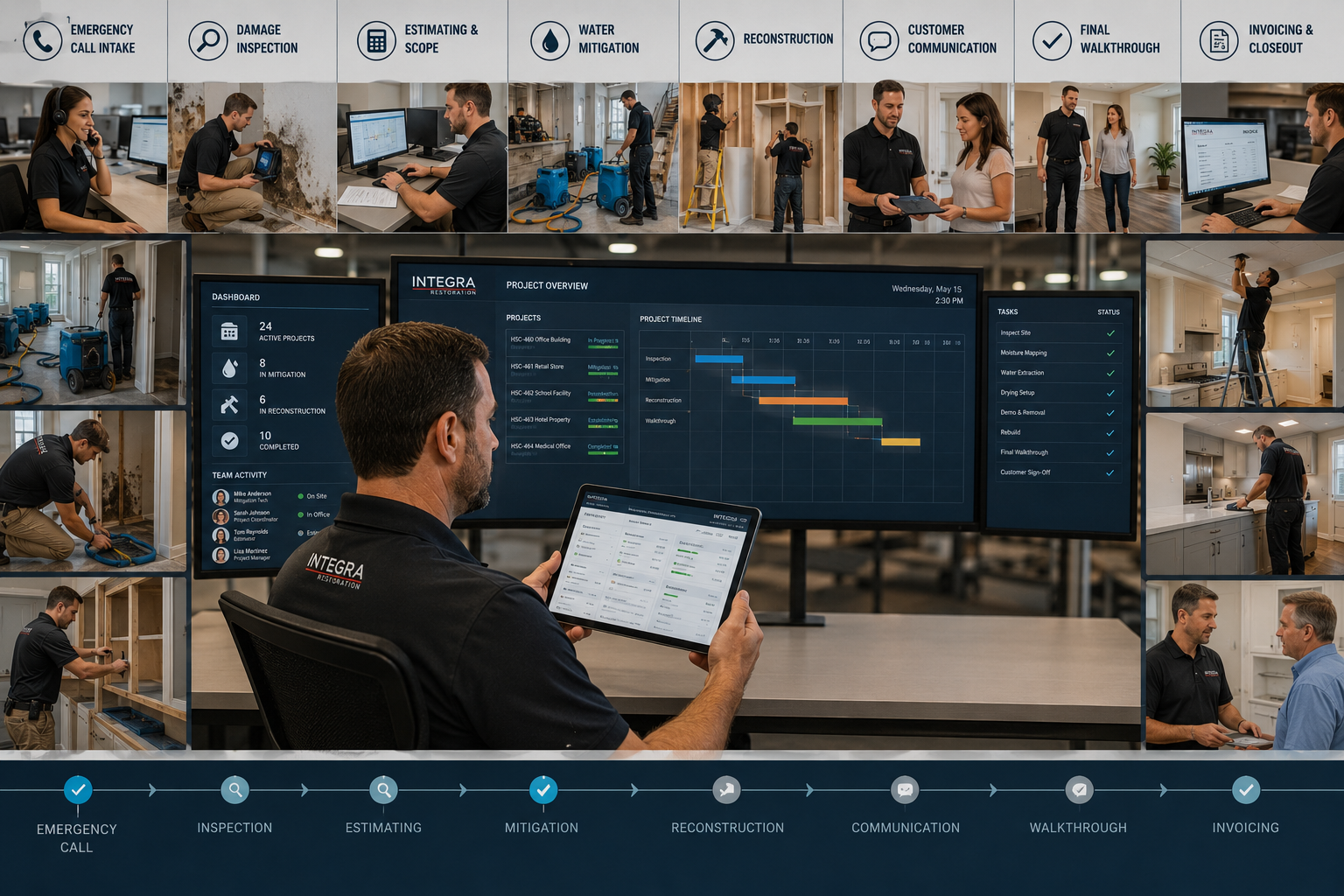
A restoration project manager may oversee several active jobs at once, but the responsibilities generally follow the same pattern from initial scope through final closeout.
Job Scoping and Documentation
A restoration PM begins by assessing the loss and developing the scope of work. This often includes moisture mapping, documenting affected areas, taking photographs, writing scopes, and preparing estimates in Xactimate or a similar platform. Accurate documentation supports insurance claims and helps prevent delays, disputes, and unexpected costs later in the project.
Crew and Subcontractor Coordination
Once work begins, the PM coordinates restoration technicians, reconstruction crews, specialty contractors, and vendors. They ensure everyone understands the scope, schedule, and project requirements while balancing resources across multiple jobs.
Timeline Management
Restoration projects move through multiple phases, including mitigation, drying, demolition, and rebuild. The PM keeps each phase moving in the correct sequence, addresses scheduling issues, and helps prevent delays that can impact customers, crews, and project profitability.
Customer and Adjuster Communication
The project manager serves as the primary point of contact throughout the project. They provide updates to customers, communicate documentation and project changes to insurance adjusters, and keep office staff and field teams aligned as conditions change.
Change Order Management
Additional moisture damage, hidden fire damage, or unforeseen conditions can expand the scope of work. The PM documents changes, manages approvals, communicates impacts to stakeholders, and helps keep the project on budget.
Job Closeout and Quality Control
Before closing a job, the PM conducts quality-control walkthroughs, verifies that work has been completed according to scope, reviews project documentation, and confirms the customer is ready for final closeout. A thorough closeout helps protect quality standards and creates a better customer experience.
NOTE FOR ROD: Which of these responsibilities causes the most problems for untrained restoration project managers? A specific example would strengthen this section and highlight the value of restoration-specific training.
The best restoration project managers combine technical expertise with leadership skills. Technical knowledge helps them understand the work and make informed decisions. Leadership allows them to manage teams, solve problems, and keep projects moving without relying on the owner for every decision.
Technical Skills
A restoration project manager needs a strong understanding of the restoration process. That includes reading drying logs and moisture readings, writing scopes of work, reviewing estimates, tracking job costs, and understanding insurance documentation requirements. They should also be comfortable using estimating platforms such as Xactimate and interpreting project data to support timely, accurate decisions.
Leadership Skills
Leadership is what separates a project manager who can run one job from one who can successfully oversee several at the same time. Strong PMs know how to delegate responsibilities, hold crews accountable, communicate confidently with customers during stressful situations, and lead team members who may have more field experience than they do.
They also make fast, informed decisions on active jobs without escalating every issue to ownership. As restoration companies grow, these leadership skills become increasingly important because they create the structure and accountability needed to scale operations without creating owner bottlenecks.
Restoration project managers and project coordinators work closely together, but they have different responsibilities.
A project coordinator typically manages scheduling, documentation, customer communication, and administrative workflows that keep projects organized. They help ensure information moves efficiently between customers, field teams, office staff, and insurance stakeholders.
A restoration project manager owns the outcome of the project. They are responsible for managing timelines, budgets, crew performance, customer expectations, and overall job success from initial scope through final closeout.
In smaller restoration companies, one person may perform both roles. In larger operations, these responsibilities are usually separated. The coordinator supports execution, while the project manager leads it and remains accountable for the final result.
For a deeper look at this role, see our guide to the restoration project coordinator position.
For many restoration professionals, becoming a restoration project manager is a natural next step in their career. While there is no single path into the role, most successful PMs follow a similar progression:
You do not need a PMP certification to become a restoration project manager. However, you do need training that reflects the realities of restoration operations.
For professionals looking to advance their careers, Restoration Project Manager Certification provides practical frameworks designed specifically for restoration professionals. You can also explore restoration project management training that support long-term growth in the industry.
A typical restoration project manager salary ranges from approximately $60,000 to $95,000 per year, depending on experience, location, certifications, and job performance.
Project managers with industry-specific training and certifications often earn toward the higher end of that range because they can lead jobs more effectively, manage profitability, and oversee multiple projects with confidence. Demand for trained restoration PMs remains strong as restoration companies continue facing skilled workforce challenges and need leaders who can drive consistent project outcomes.
Successful project management requires more than technical knowledge. It requires systems, leadership, accountability, and a repeatable approach to managing projects.
Trifecta’s certification program is designed for restoration technicians, project coordinators, and current project managers who want to strengthen their leadership and project execution skills.
The program combines restoration-specific project management frameworks, communication strategies, accountability systems, and practical leadership training. Participants learn how to manage projects more effectively, improve team performance, communicate with customers and adjusters, and drive consistent results across active jobs.
The outcome is a more confident and capable restoration project manager who can lead projects with less oversight, stronger decision-making, and greater operational consistency.
To learn more, explore the Restoration Project Manager Certification or schedule a consultation with the Trifecta team.
What does a restoration project manager do?
A restoration project manager leads jobs from initial scoping through final closeout, coordinating crews, managing timelines and budgets, communicating with customers and insurance adjusters, and maintaining quality standards throughout the project.
They oversee day-to-day project execution, keep stakeholders aligned, and ensure work is completed according to scope, documentation requirements, and customer expectations.
What is the difference between a restoration PM and a project coordinator?
A restoration project manager owns job outcomes and leads the project from initial scoping through final closeout. They are responsible for timelines, budgets, crew coordination, customer satisfaction, and overall project success.
A project coordinator supports the PM by managing scheduling, documentation, and communication between customers, field teams, and office staff. In smaller restoration companies, one person may perform both roles, while larger organizations typically separate these responsibilities.
How do I become a restoration project manager?
Most restoration project managers start as restoration technicians or project coordinators and build hands-on experience managing water, fire, mold, and reconstruction projects.
The typical path includes developing field knowledge, learning restoration-specific project management frameworks, strengthening communication and leadership skills, and earning industry-focused certifications. Programs such as Trifecta’s Restoration Project Manager Certification help professionals build the operational and leadership capabilities needed to transition from executing work to leading projects.
What skills does a restoration project manager need?
A restoration project manager needs both technical and leadership skills. Technical skills include scope writing, drying log and moisture reading interpretation, insurance documentation, estimating, and job cost tracking.
Leadership skills include delegation, accountability, customer communication, crew management, and decision-making under pressure. The most effective project managers can apply both skill sets while leading multiple projects and maintaining consistent outcomes.
What does a restoration project manager earn?
A typical restoration project manager salary ranges from approximately $60,000 to $95,000 per year, depending on experience, market, and performance. Certified PMs and professionals with advanced leadership skills often earn toward the higher end of the range.
Do I need a PMP to work in restoration project management?
No, a PMP certification is not required to work in restoration project management. While PMP is a general project management credential, restoration-specific certifications are designed to address industry-specific challenges such as emergency response, insurance documentation, customer communication, and project execution.
 Leadership Training Topics for Project and Operations Managers
 Leadership Development Tools: What Gets Used and What Gets Ignored
 How to Build a Leadership Development Plan for Operations and Project Managers
 Frontline Leadership Training: What It Is and What It Should Cover
 Leadership Communication Training: Building the Skills That Drive Results
 Leadership Assessment: Why It’s the First Step to Stronger Leaders
 Coaching Leadership Style: What It Is and How It Drives Team Performance
 Restoration Project Manager Salary: What to Expect and How to Advance
 Restoration Project Manager Certification: What It Is and How to Get Certified
 Leadership Development Programs: Building Stronger Leaders for Long-Term Success