Most restoration companies eventually face the same challenge. Either the owner acts as the project manager on every job, or multiple team members are involved but nobody is clear on who owns communication, documentation, scheduling, and job outcomes. The result is the same: customer updates are missed, drying logs fall behind, paperwork piles up, and projects run on chaos instead of systems.
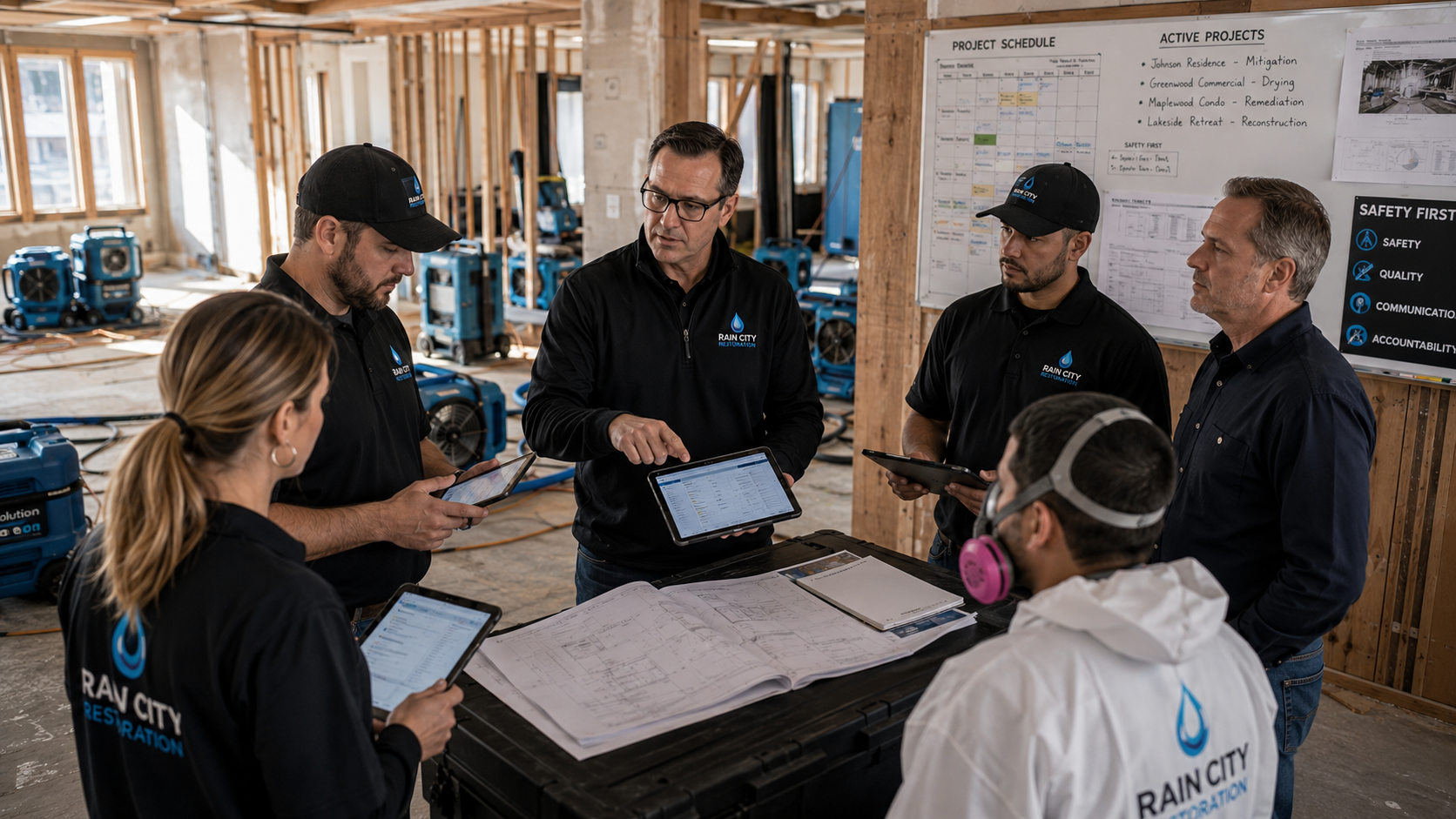
Effective restoration project management creates structure and accountability. The project manager owns scoping, crew performance, budgets, and quality. The coordinator owns customer communication, documentation, scheduling, and reporting. When those responsibilities are clearly defined, restoration companies can run more jobs simultaneously with greater consistency and less owner involvement.
Restoration project management is the system of processes, roles, and communication standards that moves a job from first call to final invoice without the owner managing every step. It is not a job title. It is the documented structure that defines ownership, accountability, and communication throughout the project lifecycle.
When restoration project management is working correctly, every phase has defined tasks, defined owners, and defined communication expectations. The restoration project manager owns job outcomes, while the restoration project coordinator manages information flow and documentation.
Intake and Scoping
The coordinator manages the initial customer contact, gathers job information, schedules inspections, and opens the job file. The PM evaluates the loss, develops the scope of work, and sets project expectations. Communication focuses on intake details, scheduling, and next steps.
Mitigation and Drying
The PM oversees mitigation activities, crew performance, and job progress. The coordinator manages drying logs, moisture readings, photo documentation, and customer updates. Communication centers on drying progress, documentation requirements, and schedule changes.
Demo and Rebuild
The PM coordinates field crews, subcontractors, reconstruction schedules, and budget performance. The coordinator supports scheduling, work authorizations, scope updates, and stakeholder communication. Communication focuses on project milestones, change requests, and timeline updates.
Closeout and Documentation
The coordinator finalizes job records, invoices, and required documentation. The PM completes final walkthroughs, verifies project quality, and addresses outstanding issues. Communication focuses on project completion, customer satisfaction, and final payment.
Restoration project management happens when these responsibilities, communication standards, and workflows are documented, understood, and consistently followed across every job.
Effective restoration project management depends on two clearly defined roles: the project manager and the coordinator. Both are essential, but each owns a different part of the system.
Project Manager: Owns Job Outcomes
The project manager is accountable for the overall success of the job, including:
As we explain in our guide on what a restoration project manager does, the PM owns the outcome of the project. They make the operational decisions that keep work moving from initial scope through final completion.
Project Coordinator: Owns Information Flow
The restoration project coordinator is responsible for keeping information organized and moving across the job. Key responsibilities include:
The coordinator ensures customers, field teams, subcontractors, and office staff have accurate information throughout the project. Their role creates the structure that allows the PM to focus on execution and decision-making.
Why These Roles Work Together
These roles are designed to support one another. The PM needs accurate information to make fast decisions about scope, budgets, scheduling, and field operations. The coordinator needs clear standards and direction from the PM to communicate consistently with customers and stakeholders.
When both roles are clearly defined and properly trained, accountability improves, communication becomes consistent, and jobs move from intake to closeout without requiring the owner to intervene in day-to-day decisions. That is the foundation of effective restoration project management.
Consider a category 2 water loss caused by a leaking supply line. The job moves through several phases, but responsibility does not overlap. The project manager owns job outcomes, while the coordinator owns information flow.
| Project Phase | Project Manager (PM) | Project Coordinator |
|---|---|---|
| Intake & First Response | Reviews incoming job details and prepares for site assessment. | Takes the initial customer call, completes the intake form, and schedules the emergency response. |
| Scoping & Planning | Inspects the loss, develops the scope of work, and establishes the project timeline. | Documents the scope, updates job records, and communicates next steps and timeline expectations to the customer. |
| Mitigation & Drying | Oversees field execution, equipment placement, and drying progress. | Tracks drying logs and moisture readings, maintains documentation, and provides daily customer updates. |
| Demo & Rebuild | Manages crews, subcontractors, quality standards, budget performance, and schedule execution. | Coordinates subcontractor scheduling, tracks project updates, and monitors budget activity against the estimate. |
| Closeout & Documentation | Conducts the final walkthrough and approves project completion. | Finalizes documentation, processes payment paperwork, and sends the Google review request. |
The handoff remains consistent throughout the job: the PM leads execution and decision-making, while the coordinator manages communication, documentation, and reporting. When both roles are clearly defined and properly trained, restoration projects move from intake to closeout with greater consistency and less owner involvement.
When restoration project management breaks down, owners often assume they have a people problem. In reality, many operational issues are role-definition problems. When ownership is unclear, communication becomes inconsistent, documentation falls behind, and the owner becomes the default decision-maker for routine issues.
Common failure modes include:
These issues create delays, frustrate customers, and pull owners back into day-to-day operations. The root cause is rarely a lack of effort or talent. More often, it is a lack of clearly defined responsibilities.
The solution is not hiring better people. The solution is building better systems. When project managers and coordinators have defined ownership, accountability becomes clear, communication becomes consistent, and restoration projects can move from intake to closeout without constant owner involvement.
Most restoration companies do not struggle because of effort. They struggle because ownership, communication, and accountability are unclear. A functioning restoration project management system starts with structure.
Document the Job Process and Assign Ownership
Begin by mapping every phase of the job, from intake and scoping through mitigation, reconstruction, and closeout. Then assign ownership for every task. The coordinator owns customer communication, scheduling, documentation, and reporting. The PM owns scoping, crew accountability, adjuster relationships, budgets, quality control, and timelines.
When responsibilities are documented through SOPs, fewer decisions need to be escalated to ownership.
Train Both Roles for Restoration-Specific Work
Project managers and coordinators require different training. PMs need leadership, scoping, budgeting, and operational decision-making skills. Coordinators need expertise in documentation standards, scheduling, workflow management, and customer communication.
Restoration-specific training provides practical systems designed for restoration operations, not generic management theory.
Create a Consistent Communication Rhythm
PMs and coordinators should meet regularly to review active jobs, documentation status, customer concerns, scheduling issues, and upcoming deadlines. The goal is not more meetings. It is predictable communication and faster problem resolution.
Build Accountability Into the System
Accountability should be defined before problems occur. Every team should know:
When ownership, training, communication, and accountability are clearly defined, restoration project management becomes scalable instead of owner-dependent. Many companies begin by strengthening these foundations through Trifecta’s training and leadership development programs.
Many restoration companies already have future project managers and coordinators on their team. The challenge is not finding talent. It is developing it.
Why Internal Development Often Delivers Better ROI
Training internal candidates often delivers a stronger return than hiring externally. Existing employees already understand your customers, workflows, documentation standards, and company culture. That institutional knowledge is difficult to replace.
Internal development is typically faster to operationalize because employees already understand company expectations. It is also often less costly than a bad external hire that creates disruption, delays, and turnover.
Assess Readiness Before Investing in Training
Training only works when the person has the right foundation. Strong PM candidates typically demonstrate leadership, accountability, and decision-making under pressure. Strong coordinator candidates often excel in communication, organization, documentation management, and follow-through.
Technical skills can be taught. Ownership, discipline, coachability, and consistency are often stronger predictors of long-term success.
This is why Trifecta evaluates candidate readiness before development. The Leadership Insights Package helps owners assess leadership potential, identify development opportunities, and make more informed promotion decisions.
External hiring may be necessary during rapid growth or when specialized expertise is required. However, many restoration companies discover their next PM or coordinator is already on the team and simply needs the right training and support.
Effective restoration project management requires more than one strong employee. It requires trained project managers, skilled coordinators, capable leaders, and systems that support accountability.
Trifecta Growth Institute helps restoration companies develop each layer of the operations team through:
Rather than focusing on a single role, Trifecta’s approach develops the people and systems required to scale with confidence.
To learn more, explore restoration PM training, restoration coordinator training, or schedule a consultation to discuss your team’s goals and operational challenges.
What is restoration project management?
Restoration project management is the system of roles, processes, and communication standards that moves a restoration job from intake to closeout. The restoration project manager owns job outcomes, while the restoration project coordinator manages communication, documentation, scheduling, and reporting that keep the job moving.
What is the difference between a restoration PM and a restoration coordinator?
A restoration project manager owns project outcomes, including scoping, crew accountability, adjuster communication, budget performance, quality standards, and timelines. A restoration project coordinator owns information flow, including customer updates, scheduling, documentation, work authorizations, and internal reporting that support the PM’s decisions.
How do I build a project management team for my restoration company?
Start by documenting every phase of the job and assigning clear ownership for communication, documentation, scheduling, and project outcomes. Then train both roles through restoration-specific programs and establish accountability systems for job reviews, documentation standards, and issue escalation.
What training does a restoration project manager need?
A restoration project manager needs training in scoping, job planning, crew leadership, budgeting, customer communication, accountability, and operational decision-making. Restoration-specific programs provide practical frameworks that prepare PMs to manage active restoration projects and lead teams effectively. Learn more about restoration project management training.
How do I know if my restoration coordinator needs training?
Your coordinator may need training if documentation falls behind, customers are not receiving consistent updates, work authorizations are missing, or project managers are handling communication that should be managed through the office. These issues often indicate gaps in systems, documentation standards, or role-specific training rather than effort or commitment.
Can one person do both the PM and coordinator roles?
Yes, many smaller restoration companies combine both responsibilities into a single role. However, as job volume grows, separating project management and coordination functions typically improves communication, documentation quality, accountability, and the ability to manage multiple jobs simultaneously.
 Leadership Training Topics for Project and Operations Managers
 Leadership Development Tools: What Gets Used and What Gets Ignored
 How to Build a Leadership Development Plan for Operations and Project Managers
 Frontline Leadership Training: What It Is and What It Should Cover
 Leadership Communication Training: Building the Skills That Drive Results
 Leadership Assessment: Why It’s the First Step to Stronger Leaders
 Coaching Leadership Style: What It Is and How It Drives Team Performance
 Restoration Project Manager Salary: What to Expect and How to Advance
 Restoration Project Manager Certification: What It Is and How to Get Certified
 Leadership Development Programs: Building Stronger Leaders for Long-Term Success