Introduction
Most leadership development tools begin with good intentions and end up forgotten in a folder.
A team completes an assessment. Managers leave a workshop with printed worksheets. Everyone creates a development plan. Then the week begins, priorities shift, and those tools quietly disappear.
Sometimes the tool is poorly matched to the problem. More often, it fails because no structure exists for using it consistently.
The leadership development tools that survive a real workweek fit naturally into how leaders already work. They prompt a specific action, create visible accountability, and connect development to real decisions.
The standard is simple: a tool should help people practice leadership, not just learn about it.

Why Most Leadership Development Tools Do Not Survive Contact With a Real Week
Leadership development tools often fail for a simple reason: learning is treated as an event instead of a system.
A two-hour workshop can create momentum, but that momentum competes with overflowing inboxes, customer issues, staffing challenges, and daily operations as soon as leaders return to work. Any tool that depends on extra time, separate systems, or memory is likely to be abandoned.
The tools that disappear tend to share a few characteristics:
- They’re completed once and never revisited.
- They feel disconnected from everyday work.
- They rely on memory instead of routine.
- Success isn’t measured or discussed again.
Tools stay active when they are short, tied to a recurring responsibility, and reviewed with another person. A five-minute weekly reflection connected to a team meeting is easier to repeat than a 30-page workbook completed once and stored away.
Leadership growth comes from consistent behavior supported by simple systems, not from completing a tool once.
Assessments: What They’re Genuinely Good For and Where They Get Overused
Assessments can be useful leadership development tools, but they are often asked to do work they cannot do.
A quality assessment provides awareness. It helps leaders understand strengths, blind spots, communication patterns, or readiness for greater responsibility. That’s a useful starting point.
What assessments don’t do is create change by themselves.
Too many organizations mistake insight for development. Someone receives a detailed report, discusses it in a meeting, and everyone assumes growth has begun. In reality, awareness without action rarely changes behavior.
Treat an assessment as the beginning of a development conversation, not the finish line.
Trifecta’s Leadership Assessments help organizations identify strengths, blind spots, and priorities that can guide focused development.
Repeating an assessment does not replace development. Use the results to identify clear priorities, then practice those priorities through coaching, feedback, and structured development.
Development Plans Work Only When They Stay Active
Many leadership programs include an individual development plan. The problem is that completing the document often becomes the finish line.
The issue isn’t the document. It’s how it’s managed.
A development plan becomes useful when it evolves alongside real work. Instead of listing ambitious goals that sit untouched, effective plans focus on a small number of leadership behaviors that can be practiced immediately.
Examples include:
- Leading team meetings with clear agendas and documented decisions
- Delegating work with clear outcomes, authority, and deadlines
- Delivering regular performance feedback with documented follow-up
- Making timely decisions within defined authority
These behaviors are observable, measurable, and relevant to daily leadership responsibilities.
A development plan also needs regular checkpoints. Monthly conversations keep progress and obstacles visible, while waiting for an annual review allows the plan to go stale.
The Leadership Development Plan guide shows how to turn leadership priorities into practical activities, milestones, success measures, and a review cadence.
The goal is not a perfect document. It is a plan that continues to guide action, feedback, and accountability.
Coaching and Feedback Structures: What Makes Them Stick
If one leadership development tool deserves more attention, it’s coaching.
Leadership isn’t developed in isolation. A coach or manager helps leaders reflect on real decisions, adjust their behavior, and stay accountable for the next action.
Coaching does not require a lengthy formal session every week. It can happen through short, consistent conversations focused on specific behaviors:
Clear expectations
Leaders know exactly what they’re practicing instead of trying to improve everything at once.
Frequent feedback
Feedback arrives close enough to the event for the leader to remember the context, examine the decision, and apply the lesson to the next situation.
Accountability
Progress becomes visible because someone follows up on the commitment, reviews the evidence, and agrees on the next action.
Peer feedback can reinforce the same structure. When leaders exchange specific observations and discuss real situations, development becomes part of recurring work instead of a separate initiative.
Consistency is the common thread. Coaching works when it reinforces application, not when it simply adds more information.
Microlearning and Course Libraries Have One Honest Limitation
Microlearning addresses a genuine problem: busy leaders often cannot step away from daily work for hours of training.
Short courses make learning accessible. A focused lesson on delegation, communication, or conflict resolution is much easier to complete than an all-day seminar. They also allow leaders to learn exactly what they need when they need it.
That’s a meaningful advantage.
But here’s the limitation that often gets overlooked: content alone doesn’t change behavior.
Watching ten leadership videos is still consumption. Growth happens when leaders apply one lesson, receive feedback, and repeat the behavior until it becomes natural.
Micro courses become useful when they’re connected to:
- Active coaching
- Real workplace challenges
- Development plans
- Ongoing accountability
Without those elements, a well-built content library can still become another resource people intend to finish someday.
Content supports development only when leaders use it to change what they do next.
The Leadership Development Tools That Actually Get Used
After the excitement of training fades, only a handful of tools tend to remain in regular use. They are not necessarily sophisticated. They stay active because they fit into everyday leadership.
| Tool | Why it gets used |
|---|---|
| Leadership assessments | Provides a shared starting point for identifying priorities |
| Individual development plans | Connects goals to behaviors and review checkpoints |
| Weekly coaching conversations | Creates a recurring place for reflection and follow-up |
| Feedback frameworks | Gives leaders a consistent process for difficult conversations |
| Microlearning modules | Offers focused instruction for a current challenge |
These tools share one trait: none creates leadership growth on its own.
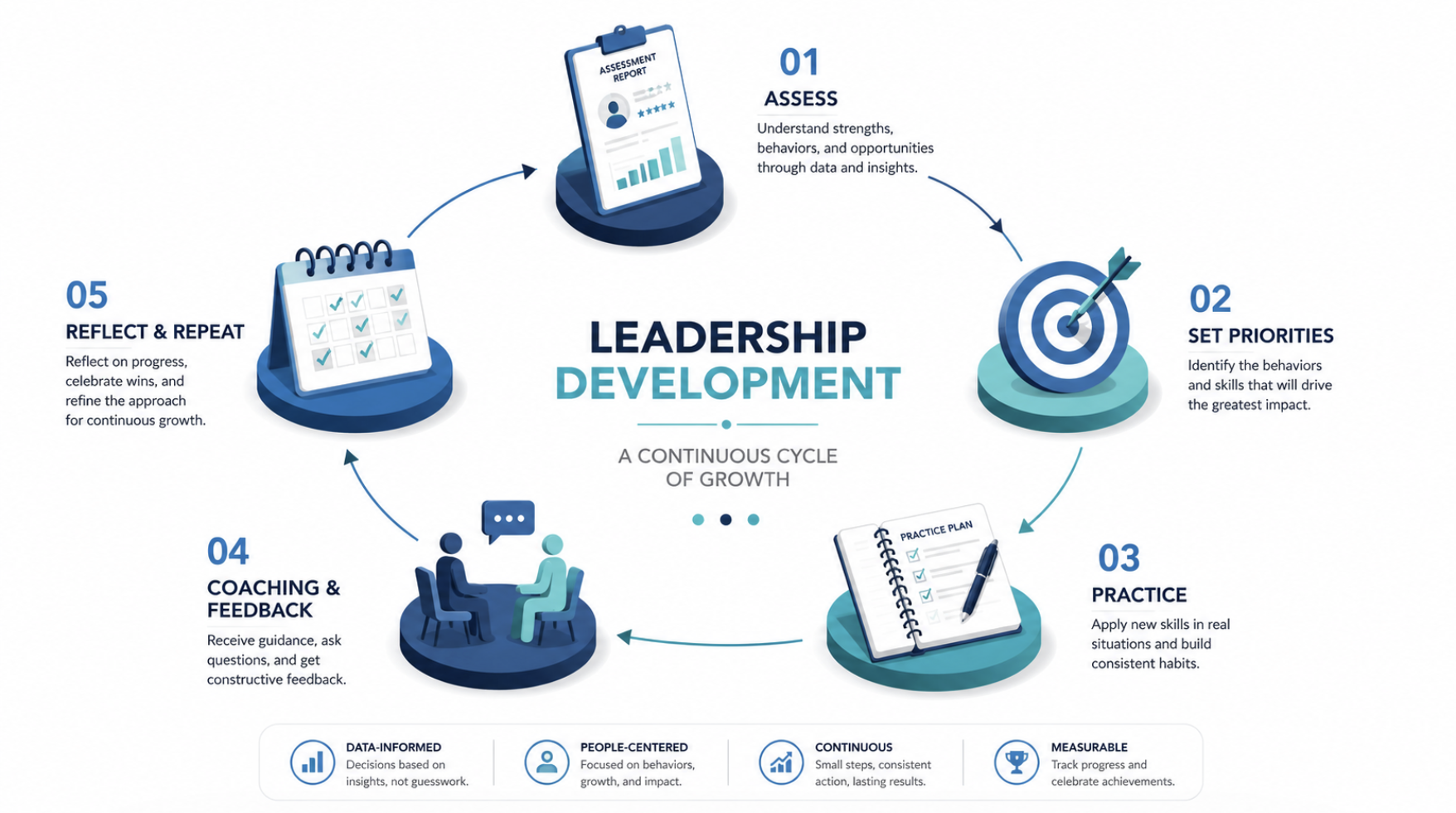
Each becomes useful as part of a repeatable structure combining awareness, practice, feedback, and accountability. That structure connects learning to observable behavior on the job.
Structure matters more than novelty because it gives leaders a clear way to apply, review, and repeat what they learn.
How to Choose a Tool for the Problem You Actually Have
Organizations often choose leadership development tools because they’re popular. A better approach is to choose them based on the challenge you’re solving.
If leaders lack self-awareness
Start with an assessment. Use it to identify development priorities and begin coaching conversations tied to those priorities.
If new managers struggle with consistency
Focus on development plans paired with regular check-ins. Consistent habits matter more than complex documentation.
If communication is creating friction
Introduce a structured feedback process and practice it with current situations. Repetition helps leaders use the process when a difficult conversation is no longer hypothetical.
If time is the biggest obstacle
Use microlearning to deliver practical lessons in manageable pieces. Connect every lesson to a current responsibility, follow-up conversation, or observable behavior.
The right tool is rarely the one with the longest feature list. It’s the one your leaders will actually use next Tuesday, during a difficult conversation, a team meeting, or a decision that shapes the business.
Leadership development becomes real when the tool changes what the leader does in that moment.
Frequently Asked Questions
What are the most common leadership development tools?
The most common leadership development tools include assessments, individual development plans, coaching conversations, feedback frameworks, and microlearning courses. They become useful when they support an ongoing development system with practice, feedback, and accountability rather than operating as standalone activities.
Do leadership assessments actually work?
Yes, leadership assessments can help leaders build self-awareness and identify development priorities. Their value depends on what happens next: leaders need to turn the results into specific behaviors, coaching conversations, and practical action.
What is the difference between a leadership tool and a leadership program?
A leadership tool is a specific resource, such as an assessment or development plan. A leadership program combines multiple tools with structured learning, coaching, practice, feedback, and accountability over time.
How do you measure whether a leadership tool is working?
A leadership tool is working when leaders use it consistently, and the target behavior changes in real work. Evidence can include meetings with clear decisions, delegated work completed without repeated intervention, feedback conversations with documented follow-up, and fewer routine issues escalated to senior leaders. Review that evidence during regular coaching conversations and adjust the tool if it is not changing behavior.
What tools work best for first-line and frontline leaders?
First-line and frontline leaders need tools that fit into daily work: focused assessments, simple development plans, structured feedback frameworks, brief coaching check-ins, and short microlearning modules tied to current responsibilities. The tool should help them handle the next team meeting, delegation decision, or performance conversation, not add another separate process.
Turn Leadership Development Tools Into Consistent Practice
Leadership development tools do not create growth on their own. They need a structure that connects learning with practice, coaching, feedback, and accountability.
Explore Trifecta Growth Institute’s Leadership Mastery Program for structured learning, coaching, and practical application that help leaders strengthen communication, delegation, accountability, and consistent execution.