Restoration project management is one of the fastest paths to increased earning potential in the trades, but restoration project manager salary varies based on certification, experience, location, and the scope of work you manage. According to Glassdoor, U.S. restoration project managers earn an average of $80,656 per year, with a typical range of $63,450 to $103,202, depending on experience and location.
Whether you’re an experienced restoration professional or planning to move into restoration project managers roles, understanding what affects compensation can help you make informed career decisions. This guide breaks down salary expectations at different career stages, the factors that influence earning potential, and how certification can strengthen your long-term career opportunities.
If you’re researching restoration project manager salary, you’ll likely find different figures across salary sources. That’s expected because each source uses a different methodology.
According to Glassdoor, U.S. restoration project managers earn an average of $80,656 per year, with most salaries falling between $63,450 and $103,202. The highest earners, representing the top 10%, can earn up to $128,320 annually.
Indeed reports an average salary of $73,623 per year. Its data comes from a broader mix of job postings, including smaller and regional restoration companies, resulting in a lower average than Glassdoor. Together, these sources provide a balanced view of current market compensation.
Salary typically progresses as restoration project managers take on greater responsibility:
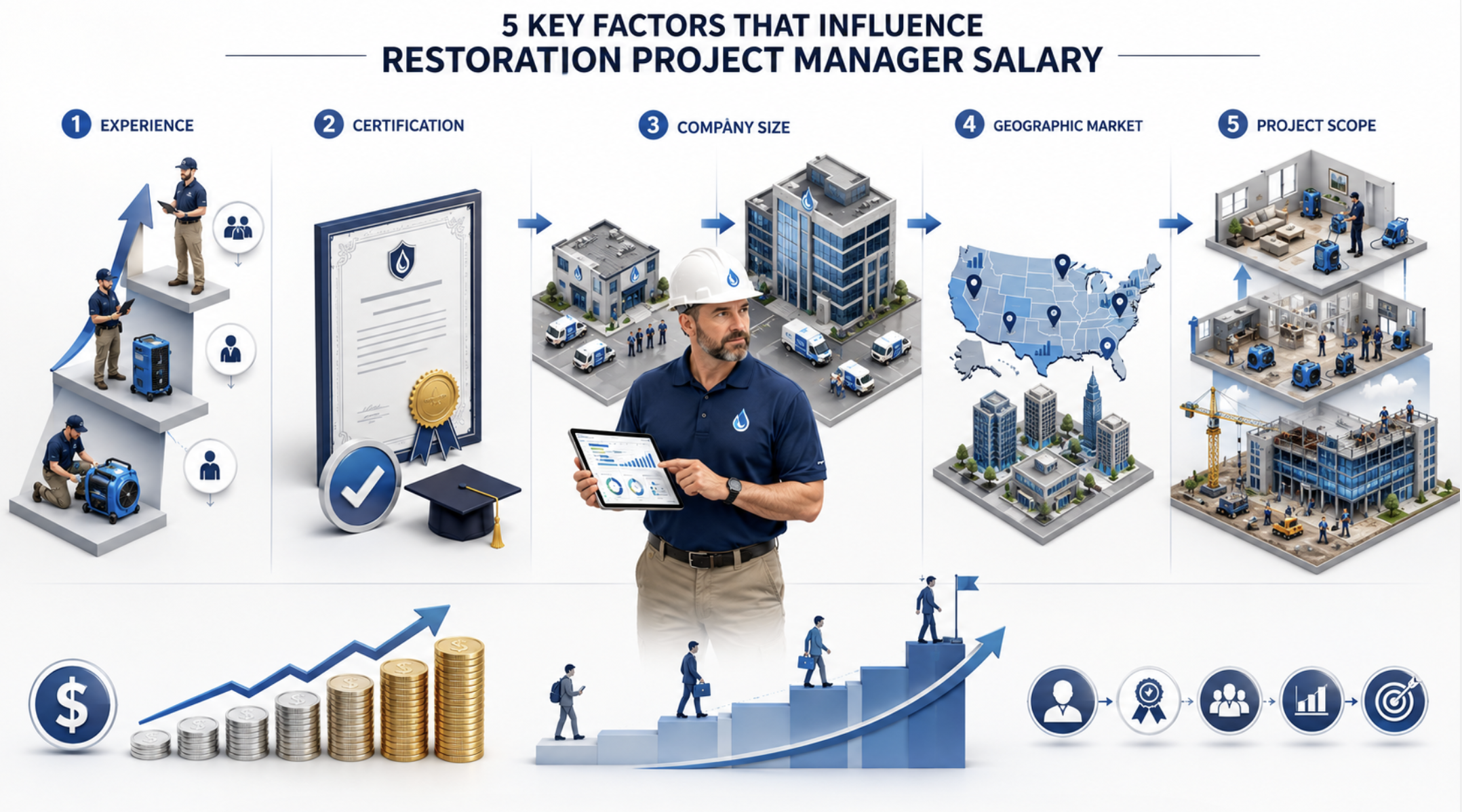
Published salary ranges provide a useful benchmark, but a restoration project manager salary depends on several factors, including experience, certification, company size, geographic market, and the scope of projects managed.
Experience
Experience remains one of the strongest drivers of compensation. Employers value restoration project managers who consistently deliver projects on schedule, manage budgets, communicate effectively with customers, insurance adjusters, subcontractors, and internal teams, and keep restoration projects moving efficiently.
As project managers take responsibility for larger losses, multiple crews, and more complex projects, they become stronger candidates for promotions and higher compensation.
Certification Status
Certification gives employers a verified credential, not just a claim on a resume. It demonstrates that a project manager has completed structured restoration project management training and meets established standards.
Combined with proven job performance, certification can strengthen promotion opportunities and salary negotiations.
Company Size
Company size also affects earning potential. Smaller restoration companies often require project managers to oversee estimating, scheduling, customer communication, and daily operations. Larger regional or national firms may offer more specialized responsibilities, structured career paths, and opportunities to manage higher project volumes or more complex losses.
Geographic Market
Salary expectations vary by geographic market. Regions with higher demand for restoration services or higher operating costs often offer more competitive compensation. Benefits, advancement opportunities, and total compensation should also be considered alongside base salary.
Project Scope
The type of work you manage has a direct impact on earning potential. Project managers overseeing mitigation-only jobs typically coordinate emergency response and stabilization work. Those managing mitigation and full reconstruction oversee larger budgets, multiple trades, longer project timelines, and ongoing communication with property owners and insurance representatives.
Because full-scope reconstruction projects require greater coordination, accountability, and technical oversight, restoration project managers with this experience often command higher salaries than those managing mitigation work alone.
Professionals moving from general construction often ask whether restoration project management offers comparable pay. In many cases, compensation is similar at the mid-to-senior level, but restoration is a specialized niche with additional responsibilities that can strengthen earning potential.
Unlike planned construction projects, restoration work begins after water, fire, storm, or mold damage. A restoration project manager must coordinate emergency mitigation, manage insurance timelines, communicate with property owners and insurance adjusters, and adapt to changing job site conditions while keeping projects on schedule.
These restoration-specific responsibilities require rapid decision-making, strong stakeholder communication, and the ability to manage both mitigation and reconstruction projects. Those skills are not typically required in general construction project management, making experienced restoration project managers valuable to employers.
For professionals transitioning from construction, core project management skills transfer well. Expanding your expertise in insurance documentation, emergency response, and restoration workflows can strengthen your qualifications and long-term earning potential.
Experience remains the primary driver of restoration project manager salary, but certification can strengthen your negotiating position. Unlike experience listed on a resume, a professional certification is a credential employers can verify, providing additional confidence in a candidate’s knowledge and readiness.
When candidates have similar project experience, certification can demonstrate preparedness to manage larger restoration projects, lead teams, oversee mitigation and reconstruction work, and handle the operational demands of restoration project management.
Certification should be viewed as one part of a broader career strategy, not a guarantee of higher pay. The strongest earning potential comes from combining verified training with successful project delivery, leadership experience, and the ability to manage increasingly complex restoration projects.
If you’re evaluating certification as part of your career progression, learn more about Trifecta’s restoration project manager certification and how it prepares professionals to lead restoration projects from kickoff to closeout.
Most professionals advance in restoration project management by demonstrating accountability, expanding their leadership responsibilities, and successfully managing more complex restoration projects. While responsibilities vary by employer, the typical career path follows a clear progression.
| Role | Typical Responsibilities | Skills Developed | Compensation Progression |
|---|---|---|---|
| Restoration Project Coordinator | Coordinate schedules, maintain project documentation, communicate with customers, and support project execution. | Organization, communication, customer service, attention to detail | Typically below the published restoration project manager salary range. |
| Restoration Project Manager | Manage crews, budgets, schedules, vendors, insurance timelines, and day-to-day project execution. | Leadership, estimating, project management, problem-solving | Most professionals fall within the published salary range, depending on experience, location, and employer. |
| Senior Project Manager | Lead larger or multiple restoration projects, mentor project managers, and oversee mitigation and reconstruction work. | Strategic planning, coaching, advanced project coordination | Compensation generally trends toward the upper end of the published salary range as responsibility increases. |
| Operations Manager | Lead operations, develop project managers, improve processes, and support business performance. | Leadership, financial oversight, operational management, decision-making | Compensation typically exceeds project manager pay and varies by employer, market, and operational responsibility. |
As you review a restoration project manager job description, you’ll consistently see leadership, accountability, project management experience, and the ability to manage restoration projects with minimal supervision. Developing these capabilities prepares you for advancement throughout a career in restoration project management.
Promotion to restoration project manager is based on demonstrated performance, leadership, and the ability to manage restoration projects with minimal oversight. Use this checklist to evaluate your readiness:
As you review a restoration project manager job description, you’ll consistently see these qualifications in hiring and promotion decisions. Strengthening these capabilities helps prepare you for greater responsibility and long-term career growth in restoration project management.
How much does a restoration project manager make?
According to Glassdoor, the average restoration project manager salary is $80,656 per year, with a typical range of $63,450 to $103,202, depending on experience, location, and employer. Indeed reports an average of $73,623 per year based on a broader pool of U.S. job postings.
What affects a restoration project manager’s salary?
Experience, certification status, geographic market, company size, and project scope all influence compensation. For example, a restoration project manager overseeing mitigation and reconstruction projects typically earns more than one managing mitigation-only work.
Can certification increase a restoration PM’s salary?
Yes. Certification provides employers with a verified credential that can strengthen your position during salary negotiations and promotion discussions. Learn more about Trifecta’s restoration certifications.
What is the career path from restoration coordinator to project manager?
Most restoration professionals progress from Restoration Coordinator to Restoration Project Manager, then Senior Project Manager, and eventually Operations Manager. Each step typically requires more experience, demonstrated accountability, leadership, and often formal certification.
How does restoration PM pay compare to general construction PM?
Restoration project management is a specialized niche, and compensation is generally comparable to general construction project management at the mid and senior levels. Restoration roles also require expertise in insurance timelines, emergency response, and reconstruction that many general construction positions do not.
Your restoration project manager salary is influenced by the experience you gain, the complexity of the projects you manage, and the credentials you earn throughout your career. Building leadership capability and industry-specific expertise can strengthen your position for promotions and salary negotiations over time.
If you’re ready to advance your career, explore Trifecta’s restoration project manager certification. The program provides structured, 50-hour restoration project management training designed to help professionals build the knowledge, leadership skills, and practical experience needed to lead restoration projects with greater confidence. Whether you’re preparing for your first project management role or working toward senior leadership, the right training can help you take the next step with confidence.
 Leadership Training Topics for Project and Operations Managers
 Leadership Development Tools: What Gets Used and What Gets Ignored
 How to Build a Leadership Development Plan for Operations and Project Managers
 Frontline Leadership Training: What It Is and What It Should Cover
 Leadership Communication Training: Building the Skills That Drive Results
 Leadership Assessment: Why It’s the First Step to Stronger Leaders
 Coaching Leadership Style: What It Is and How It Drives Team Performance
 Restoration Project Manager Salary: What to Expect and How to Advance
 Restoration Project Manager Certification: What It Is and How to Get Certified
 Leadership Development Programs: Building Stronger Leaders for Long-Term Success